
A useful packing checklist should do more than remind you to pack socks. It should catch the mistakes that appear after the bag is packed: the wrong allowance, a pocket that now bulges, an item that needs a separate security check, or a return flight with different conditions.
This printable worksheet is organised around those decisions. It has two pages: one for the booking and packed bag, and one for departure, possible gate-checking and the journey home.
Get the Carry-On Packing Checklist
A two-page preparation worksheet for checking the booked allowance, packed bag and return journey.
Direct file download. No account, timer or ad interaction required.
Other format: Download editable text
- Format and size
- PDF — 76,718 bytes; TXT — 2,342 bytes
- Version
- 1.0
- Requirements
- A PDF reader or printer for the printable version; a plain-text editor for the editable version.
- Source and reuse
- Original PrismGist checklist. It records the rules you verify; it is not an airline or airport approval. No separate reuse license is asserted.
How to use it
Check each operating airline and departure airport for your actual trip. Fill in the packed-bag dimensions and repeat the checks for connections and the return flight.
Related resources
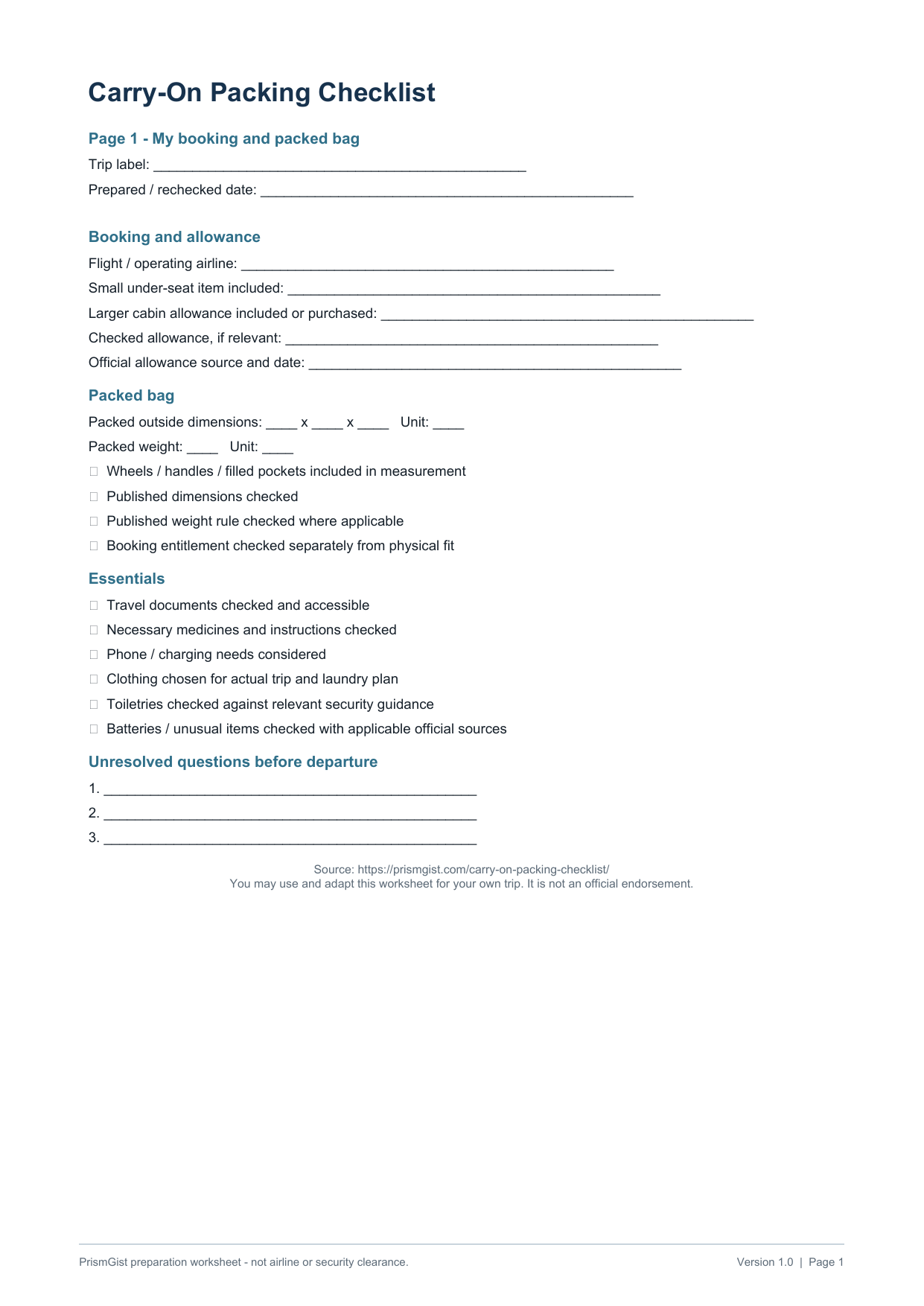
It is a preparation worksheet, not permission from an airline or airport. It deliberately leaves changing limits as fields to verify rather than printing one rule as though it applies everywhere.
Check the allowance you actually bought
Write down the operating airline and what your booking includes. Separate the small under-seat item from any larger cabin bag or checked bag.
A bag fitting a published larger-cabin size does not establish that your ticket includes that allowance. Conversely, buying a baggage add-on does not establish that an oversized or overweight bag meets its conditions.
Record the source you checked and the date. For multiple airlines, complete a line for each relevant flight instead of assuming the first airline’s allowance covers the whole trip.
PrismGist’s easyJet Small vs Large Cabin Bag guide can help organise the easyJet decision. The Ryanair cabin-versus-checked guide addresses a different question: which baggage product and handling process you are choosing.
Measure after packing
Measure the bag at its widest outside points in the condition you intend to take it to the airport. Include wheels, fixed handles and filled pockets.
Manufacturer dimensions are a useful starting point, but they do not tell you how far a soft pocket protrudes after packing. Record the three dimensions without trying to make an over-limit measurement disappear by rounding down.
The worksheet has separate boxes for dimensions, weight and the allowance checked. A size result does not replace a weight check where one applies.
Do not treat internet stories about relaxed enforcement or oversized sizers as an entitlement. A packing worksheet cannot predict a gate agent’s decision.
Separate security questions from baggage questions
The airline’s cabin allowance and the departure airport’s security rules answer different questions. A bottle can fit neatly in a bag and still need a different security check. An item may be allowed in one baggage location but not another.
Use the worksheet to record anything requiring verification: liquids, medicines, batteries, sharp items or unusual equipment. Check the relevant official authority and airline information for the actual journey.
For UK departures, the government’s hand-luggage guidance is a useful starting point. For a US battery question, the FAA PackSafe guidance is a relevant starting point. Neither is a universal rulebook for every route.
Prepare a removable gate-check pouch
Before departure, decide what you would need to remove if your cabin bag had to travel in the hold. Keep documents, essential medicines and valuables easy to retrieve. Check the applicable rules for batteries and other items that cannot simply stay in a checked bag.
The point is to prepare while you have time, not to repack in a queue. The worksheet includes a “remove and recheck” list rather than claiming that every item is allowed in every cabin or hold.
Keep sensitive document numbers off a printed checklist that might be lost. “Passport packed” is enough; the passport number is unnecessary.
Repeat the checks for the journey home
The return airport, operating airline and contents of your bag may differ. Shopping can change the bag’s dimensions and weight. A connection can add another security checkpoint.
Keep separate outbound, connection and return lines. Reusing the same bag does not mean every condition remains the same.
Download and use
Print the two-page PDF or edit the text version for your trip. Cross out irrelevant categories instead of treating the checklist as an instruction to carry everything listed.
No account or upload is needed to use the files. They do not certify compliance, guarantee boarding or replace instructions from the airline, airport or responsible authority.
Is this a universal list of permitted items?
No. It helps you record the checks for your own trip.
Should I use empty-bag or packed-bag measurements?
Use the packed outside measurements you expect to present at the airport.
Must I fill in every box?
No. Complete the checks relevant to your trip, but do not skip a rule check merely because you do not yet know the answer.
[…] hidden behind a lining. A camera may have both an installed battery and a spare in its case. The Carry-On Packing Checklist provides a worksheet for booking, packed measurements, gate-check preparation and the return […]
[…] this card alongside the carry-on packing checklist so the charger you verified is the one you actually pack. For a battery pack, the Power Bank Flight […]
[…] packing, put the passport on your carry-on checklist and keep it accessible rather than underneath everything you packed. For an airport choice, compare […]