
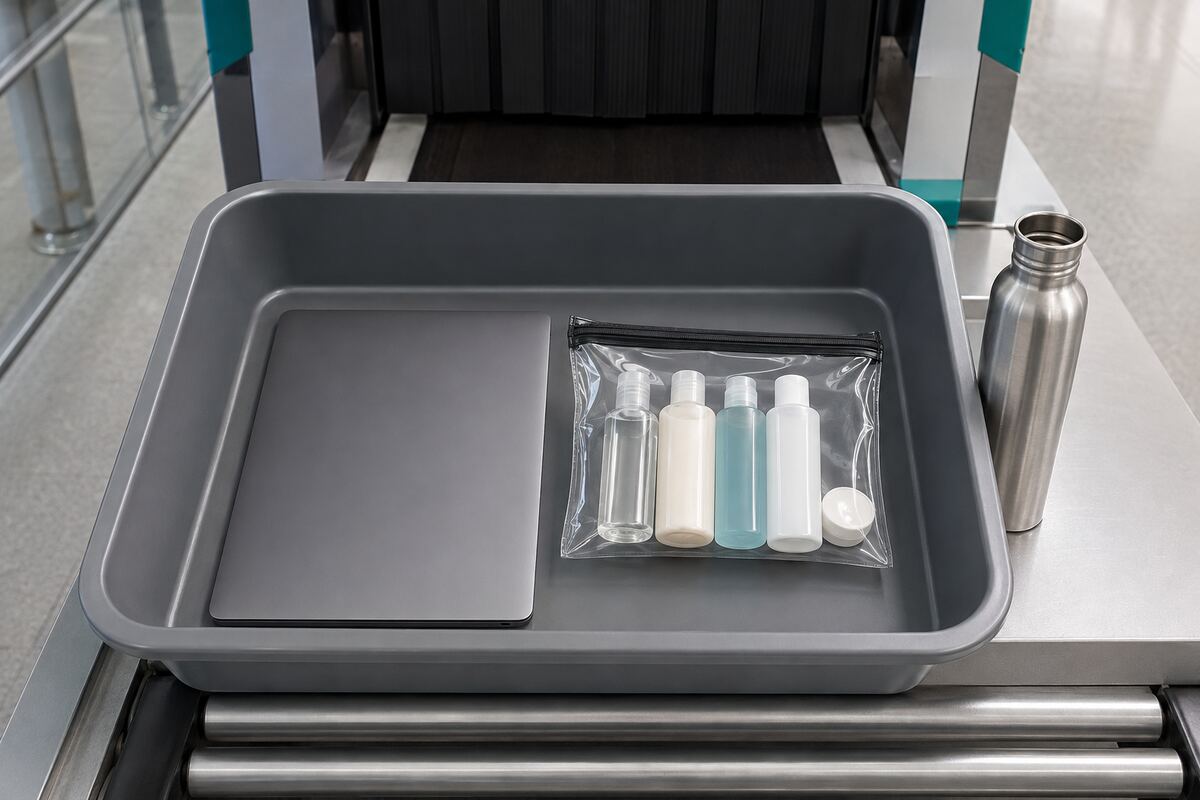
Short answer: airport liquid and laptop rules are no longer predictable from the country alone. A 2-litre container may pass at Heathrow, fail at Manchester, pass at Frankfurt Terminal 3, and fail at a Frankfurt transfer checkpoint. Build your actual route below to get one airport-by-airport packing and tray plan.
Route-specific travel tool
What stays in your bag at airport security?
Build your route from 33 verified checkpoint options, then check liquids, laptops and reusable bottles against the strictest stop.
Airport and authority sources checked August 22, 2026. This page covers 33 major checkpoint variants across the UK, Europe, the Middle East and Asia plus general TSA and CATSA rules. It is planning guidance, not a security clearance.
New in this update: Dubai (DXB), Istanbul (IST), Doha (DOH) and Singapore Changi (SIN). All four hubs recorded year-over-year passenger growth in 2025 and rank among the world’s busiest international airports in ACI World’s 2026 traffic dataset.
Why the old “100ml everywhere” answer is now wrong
Computed tomography (CT) scanners can inspect a cabin bag in three dimensions. Airports that have completed an approved rollout may let passengers leave liquids and larger electronics packed, and some now permit individual liquid containers up to 2 litres. That sounds simple until a trip includes an older lane, a different terminal, a transfer search or a destination-specific checkpoint.
The United Kingdom explicitly tells passengers to check the rules at every airport they will pass through, including connections and the return journey. The European Union still publishes a common 100ml baseline, while individual airports announce locally approved procedures. In North America, TSA and CATSA keep the familiar 100ml/3.4oz baseline, although the instruction to remove items can vary by lane or trusted-traveller programme.
That is why this checker asks for checkpoints rather than only a departure city. It applies the smallest ordinary container limit across the selected route, then gives separate tray instructions for each stop. If an airport uses mixed equipment and you cannot guarantee a CT lane, the result deliberately uses the conventional rule.
Five details that can change the answer
- The exact security checkpoint: Frankfurt Terminal 3 has CT scanners throughout, while Terminals 1 and 2 use mixed equipment. Frankfurt also tells transfer passengers to plan around the 100ml rule.
- Whether the journey starts there: Zurich permits containers up to 2L for journeys starting in Zurich, but transfer passengers remain under the 100ml/1L-bag rule.
- Your destination: Rome Fiumicino’s upgraded process does not apply in the same way to departures for the United States or Israel.
- The assigned lane: Munich has CT and conventional checkpoints. Do not pack a 2L bottle merely because CT scanners exist somewhere in your terminal.
- The type and number of containers: Prague Terminal 2 allows the normal 100ml/1L bag plus only one additional container over 100ml and up to 2L. It is not a blanket 2L rule for every bottle.
The safest packing strategy for a multi-airport trip
If every selected checkpoint publishes a 2L limit, you can plan around that route-specific allowance. If even one stop uses 100ml, pack ordinary toiletries into containers no larger than 100ml and use the required transparent bag. The capacity printed on the container matters: a half-empty 200ml shampoo bottle is still a 200ml container.
Keep liquids, laptops and tablets easy to reach even when an airport says they can remain packed. Equipment can be unavailable, a lane can change, and an officer can request a separate inspection. An empty reusable bottle is usually the low-risk choice; Heathrow, Gatwick, Edinburgh and Zurich specifically warn that metal, insulated or double-walled containers must be empty for screening.
For a codeshare itinerary, airport security rules are separate from the airline’s cabin-bag and dangerous-goods rules. If you are also carrying a portable charger, run the PrismGist Power Bank Flight Checker for every operating airline.
What counts as a liquid at airport security?
Plan conservatively for anything that is liquid, semi-liquid, spreadable, pourable, pressurised or gel-like. Common examples include drinks, shampoo, toothpaste, creams, lotions, mascara, liquid foundation, hair gel, aerosols, perfume, peanut butter, soft cheese and foods in sauces. Frozen items can become liquids while you travel, so do not assume that freezing a product avoids the rule.
Solid cosmetics and dry foods are generally simpler, but an officer decides how an ambiguous product is screened. If the item is expensive or difficult to replace, open the airport’s linked source before packing it.
Medical, baby-food and duty-free exceptions
Essential medicines, special dietary liquids and baby supplies can qualify for exceptions to the ordinary container limit. Declare them before screening, separate them when asked and allow extra time for testing. Carry a prescription, doctor’s letter or other supporting evidence when the authority or destination may require it. An exception is not automatic approval for an unlimited quantity.
Sealed duty-free liquids are a separate trap on connecting trips. Keep the item and receipt inside the security tamper-evident bag. Do not open it before the final checkpoint. A transfer authority may still inspect it, and a broken seal or missing receipt can end the exemption. The checker marks all exceptions as a manual check because no browser tool can inspect packaging, paperwork or the contents.
Verified airport rules in this launch dataset
The table is a compact index, not a substitute for the route result. “Keep packed” describes the published normal procedure; always follow the officer for the lane you actually enter.
| Airport or authority | Ordinary liquid limit | Normal tray instruction | Official source |
|---|---|---|---|
| United States — TSA | 100ml / 3.4oz; one quart bag | Remove liquids bag unless instructed otherwise; electronics vary by lane/programme | TSA |
| Canada — CATSA | 100ml; one 1L bag | Remove under the baseline; CT-line instructions may differ | CATSA |
| London Heathrow (LHR) | 2L per container | Liquids and electronics stay packed | Heathrow |
| London Gatwick (LGW) | 2L per container | Liquids and electronics stay packed | Gatwick |
| Manchester (MAN) | 100ml per container; no clear bag | Liquids stay packed; follow lane instruction for electronics | Manchester |
| London Stansted (STN) | Under 100ml; no clear bag | Liquids stay packed; follow lane instruction for electronics | Stansted |
| London Luton (LTN) | 100ml/100g; no clear bag | Liquids stay packed; follow lane instruction for electronics | Luton |
| Birmingham (BHX) | 2L per container | Liquids and electronics stay packed | Birmingham |
| Edinburgh (EDI) | 2L per container | Liquids and electronics stay packed | Edinburgh |
| Bristol (BRS) | 2L per container | Liquids and electronics stay packed | Bristol |
| Belfast International (BFS) | 2L per container | Liquids and electronics stay packed | Belfast International |
| London City (LCY) | 100ml per container | Liquids and electronics stay packed | London City |
| Dublin (DUB) | 2L per container | Liquids and electronics stay packed | Dublin |
| Cork (ORK) | 100ml; one 1L bag | Remove liquids and larger electronics | Cork |
| Amsterdam Schiphol (AMS) | 100ml; one 1L bag | Liquids and electronics stay packed | Schiphol |
| Frankfurt (FRA) | T3 local departure: 2L; T1/T2 mixed and transfer: plan for 100ml | Keep packed at T3; follow the assigned lane elsewhere | Frankfurt |
| Munich (MUC) | CT lane: 2L; conventional/unknown lane: 100ml | Keep packed at CT; remove at conventional lane | Munich |
| Prague (PRG) | T1: 100ml; T2: standard 1L bag plus one extra container up to 2L | Removal depends on terminal/lane | Prague |
| Madrid (MAD) and Barcelona (BCN) | 100ml; one 1L bag | Present liquids and larger electronics separately | Aena |
| Lisbon (LIS) | 100ml/100g; transparent bag | Present liquids separately; follow electronics instruction | ANA Airports |
| Rome Fiumicino (FCO) | Eligible T1/T3 departure: 2L; USA/Israel departure: 100ml | Keep packed on eligible routes; remove for USA/Israel process | Aeroporti di Roma |
| Zurich (ZRH) | Journey starts in Zurich: 2L; transfer: 100ml | Keep packed for local departure; transfers follow lane instruction | Zurich Airport |
| Dubai International (DXB) | 100ml; one 1L bag | Present liquids and laptops/tablets separately | Dubai Airports |
| iGA Istanbul Airport (IST) | 100ml; one 1L bag | Present liquids and larger electronics separately | Türkiye DGCA |
| Hamad International, Doha (DOH) | 100ml; one 1L bag | Present liquids separately; follow electronics and destination-specific checks | Qatar Airways |
| Singapore Changi (SIN) | 100ml; one 1L bag | Electronics normally stay packed; follow checkpoint instructions for liquids | Changi Airport |
Frequently asked questions
Can I take a 500ml bottle through airport security?
Only at a checkpoint whose current ordinary limit allows it, or under a qualifying exception. Heathrow, Gatwick and several other upgraded airports publish limits up to 2L. Manchester, Schiphol, TSA and many other checkpoints still use 100ml. An empty reusable bottle is the simplest option.
Do liquids still need a clear plastic bag in the UK?
It depends on the airport. Heathrow, Gatwick, Birmingham and several upgraded UK airports do not require the old clear bag. Manchester, Stansted and Luton also let liquids remain packed but still cap each container at about 100ml. Check every departure and transfer airport.
Can my laptop stay in my hand luggage?
At many CT checkpoints, yes. At conventional checkpoints, it generally needs separate presentation. Mixed-scanner airports can change the instruction by lane, so keep the device accessible and follow the officer rather than arguing from an airport webpage.
Does a connecting flight mean another security check?
Not always. It depends on the airports, terminals, origin country and whether the sterile transit route remains intact. Add a connection to the checker when your itinerary or airport guidance says you will be screened again. If uncertain, packing to the strictest route rule avoids an expensive surprise.
Why does the checker sometimes say “manual check required”?
That result appears for medical, baby-food or duty-free exceptions; for airports outside the verified list; and for rules that depend on same-day lane instructions. The tool refuses to turn a conditional exception into a false promise.
Method, updates and limitations
PrismGist records the container limit, bag rule, removal instruction, checkpoint variant, source URL and verification date from the airport or national authority. The calculation runs in your browser; your route and item selections are not sent to a PrismGist server. Anonymous interaction events can be counted through the site’s analytics without recording the contents of your form.
The dataset is intentionally finite and transparent. An unsupported airport receives a conservative 100ml fallback and a warning, not an invented airport-specific answer. Rules can change without notice because of equipment, maintenance, security conditions, terminal works or government direction. The security officer and relevant authority make the final decision.
If an official source linked here has changed, send PrismGist the airport, terminal, travel date and source page. That is more useful than a screenshot of an unsourced social post and helps keep the checker auditable.