
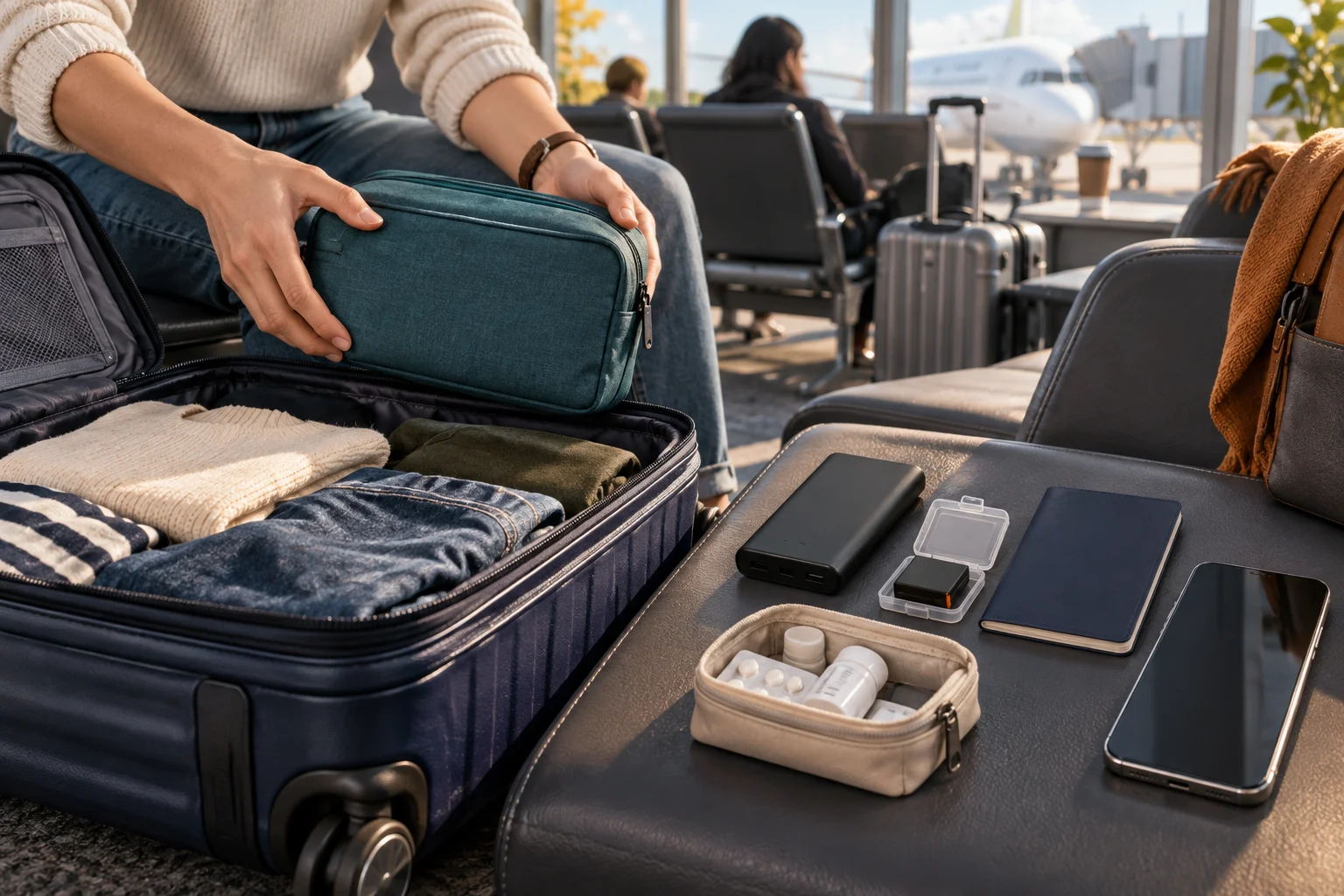
At the gate? Do not hand over the bag until you have removed power banks and spare lithium batteries, checked other cabin-only items, and taken the essentials you cannot afford to lose access to. A bag that passed security is not automatically suitable for the hold. Tell staff if you need to retrieve something before they take it.
Official sources reviewed 6 October 2026. The US and UK guidance below is scoped separately; follow the operating airline’s current instructions for your flight.
The handover checklist
- Say you need to remove cabin-only items. Check every pocket, including the charging compartment and any battery built into a smart suitcase. Ask staff about an unfamiliar item rather than guessing.
- Take out power banks and spare lithium batteries. Keep them with you in the cabin, individually protected. Include a loose camera battery or battery charging case, not just the obvious portable charger.
- Retrieve other restricted items and essential electronics. If you carry a vape, it cannot go in checked baggage under the cited FAA/CAA guidance; carriage in the cabin still depends on your route and airline. Keep your phone and any device needed for tickets or arrival arrangements accessible.
- Take documents, medicines and valuables. Keep passport, boarding pass, wallet, keys, necessary medication and irreplaceable items in your permitted cabin item. These are practical access precautions, not one universal dangerous-goods rule.
- Confirm the bag’s destination and collection point. Ask whether it is tagged to this airport or your final destination and whether collection is at the aircraft, a belt or another location. Check the tag, retain the receipt and close the bag only after the contents check.
Required removal vs recommended essentials
Use the first column to decide what to retrieve; the second explains why. On a small screen, swipe the table sideways.
| Item | Reason to remove or check | Action before handover |
|---|---|---|
| Power banks and spare/uninstalled lithium batteries | Cabin-only under the cited US FAA and UK CAA guidance | Remove, protect against damage and short circuit; follow airline quantity and storage rules |
| Vape/electronic smoking device, if permitted on your route | Not allowed in checked baggage under the cited guidance | Prevent accidental activation, remove and ask staff about carriage; do not use or recharge it on board |
| Laptop, camera or tablet with battery installed | Different treatment from a spare battery; carrier restrictions may be stricter | Prefer to retain it. Confirm the airline’s rule if it must go in the hold |
| Passport, boarding pass, wallet, keys and valuables | Recommended for access and loss/damage protection | Keep them with you, including any paper documents needed on arrival |
| Necessary medicines and medical equipment | Recommended for access; some equipment needs separate airline arrangements | Retain what you need during travel and a delay; ask about equipment-specific handling |
| Clothing, ordinary chargers without a battery, other permitted belongings | Usually a packing choice, subject to contents rules | Leave only what may safely travel in the hold; retrieve a useful change of clothes if space permits |
A power bank is not the same as a laptop battery
The FAA’s US lithium-battery guidance requires spare batteries and power banks to stay in the cabin when a carry-on is gate-checked. Protect exposed terminals: use the original packaging, a battery case or an individual protective pouch; tape can cover exposed terminals. Do not leave loose batteries with coins or keys.
The separate FAA installed-device guidance recommends cabin carriage. If an eligible device goes in checked baggage, it must be fully switched off and protected from damage and accidental activation. Sleep mode is not a full shutdown. This distinction does not establish that every battery-powered product can be checked.
For the UK, the CAA’s current passenger warning says power banks, vapes and spare lithium batteries belong in the cabin, and tells passengers to check stricter airline restrictions. British Airways’ baggage guidance, for example, directs spare batteries and power packs into the smaller underseat item in case the larger bag is checked. Its cabin-bag guidance also keeps electronics, valuables and essential medicines out of the larger bag. Treat that as BA policy, not a rule shared by every carrier.
If a battery is swollen, damaged, overheating or subject to a relevant recall, moving it to another bag does not make it acceptable. Tell staff. The Power Bank Flight Checker can help interpret the label and listed carrier conditions, but it does not inspect your device or grant airline approval; reopen the carrier’s current policy.
Pack a pouch you can actually keep
Before departure, place the must-remove items and personal essentials near the top of the roller, or inside the smaller cabin item you are allowed to keep. Protect batteries individually inside the pouch. Keep medicines identifiable and documents secure. Do not turn a useful pouch into an extra bag your fare does not allow: confirm with staff how to carry the retrieved items when you have only one cabin-bag entitlement.
Try the handover once at home: open the bag, retrieve the pouch and check the less obvious pockets. A charging cable can lead to a power bank hidden behind a lining. A camera may have both an installed battery and a spare in its case. The Carry-On Packing Checklist provides a worksheet for booking, packed measurements, gate-check preparation and the return flight; this guide provides the last-minute removal decision.
Two practical packing scenarios
Scenario 1: the roller contains your arrival plan
Illustrative scenario, not a report of a flight: a solo traveller has clothes, a laptop, a power bank, passport, house keys and necessary medication in one roller. Staff need it in the hold. The power bank comes out for cabin carriage; the passport, keys and medicine come out for access. The traveller keeps the laptop if permitted and asks staff about the remaining cabin item. Before leaving the desk, they confirm collection instructions. They do not assume the bag will return at the aircraft door.
Scenario 2: the camera battery is easy to overlook
Illustrative scenario: a family has a camera with an installed battery, two spare batteries in a side pocket, a permitted vape and a child’s essential supplies in the roller. The spare batteries and vape cannot stay in that checked bag under the cited guidance. The camera’s installed battery has a different classification, but the family retains the camera where allowed and checks the carrier’s instructions. They take the supplies they need on board and protect each spare battery separately. An unprotected pile of batteries in a shared pouch is not a completed safety check.
Ask these questions before the bag leaves
- “Can I retrieve the batteries, documents and essentials first?”
- “How should I carry these items within my remaining cabin allowance?”
- “What destination is on the tag, and where exactly do I collect the bag?”
- “Does any charge apply in my situation?”
Gate-checking can happen for different reasons, including stowage space or a baggage-policy issue. Do not assume it is always free, that a compliant size guarantees cabin stowage, or that a gate tag promises planeside return. For the broader responsibility question, read Airport Rules vs Airline Rules: baggage entitlement, security screening and dangerous-goods carriage are separate checks.
Sources and updates
Reviewed 6 October 2026: the linked FAA spare-battery, installed-device and vaping-device guidance, UK CAA passenger warning and British Airways baggage essentials. This is an original handover workflow assembled from those scoped rules and practical access decisions; it is not an official checklist or a hands-on airline test. Recheck your operating carrier, route and unusual equipment before travel.