
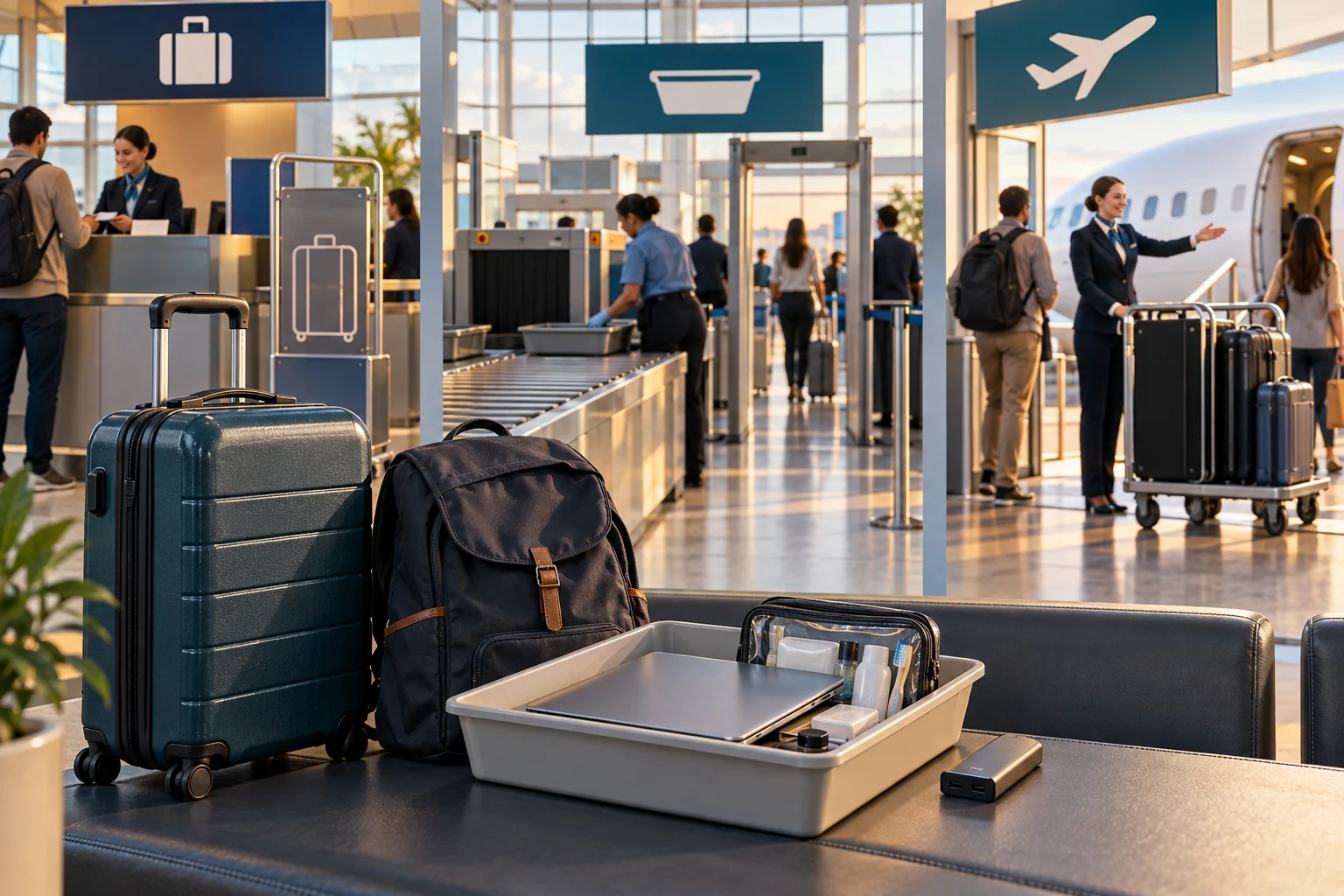
Quick answer: the airline controls what baggage your booking lets you carry; the airport’s security process controls what passes its checkpoint; aviation dangerous-goods rules and airline safety policies control how hazardous items travel. All applicable layers must be satisfied. A suitcase can pass security and still exceed your airline allowance, while a paid bag can still contain something forbidden.
Official guidance checked 4 October 2026. This is a reusable checking process, not a universal baggage allowance or permission to carry a particular dangerous item.
Who owns which rule?
Start with the question you need answered. “Can I take this bag?” mixes together its size, your fare entitlement, its contents and where it will be stowed. Separate those decisions before buying an upgrade or changing your packing.
On a small screen, swipe the table horizontally to read all columns.
| Decision | Main source to check | What that answer does not settle |
|---|---|---|
| Cabin bag dimensions and weight | Operating airline’s cabin-baggage policy, plus your booked allowance | Whether its contents pass security or it will remain in the cabin |
| Personal item: included count and underseat fit | Airline policy and the actual fare or purchased entitlement | A second bag is not automatically included because it is small |
| Checked-bag count, weight and fees | Ticket/booking baggage allowance and relevant carrier rules; confirm the applicable policy for multi-airline journeys | Permission to check every item, or a guarantee bags transfer without collection |
| Liquids at a security checkpoint | Security authority’s rules and that airport’s current instructions | Rules at another airport or dangerous-goods permission |
| Laptops/electronics at security | Checkpoint preparation instructions and country-specific security restrictions | Battery limits, airline carriage rules or permission to use a device on board |
| Power banks and spare lithium batteries | Applicable dangerous-goods authority plus operating airline’s current battery policy | A general safety ceiling does not override a stricter airline quantity, storage or use restriction |
| Prohibited or dangerous goods | Security restrictions, dangerous-goods guidance and carrier conditions for the specific item | “Not in hand luggage” does not necessarily mean “allowed in checked baggage” |
| Gate-checking a cabin bag | Gate staff and operating airline’s stowage process | Contents do not become safe for the hold when the bag receives a tag |
| Codeshare: seller vs operator | “Operated by” details for every leg, the ticketed allowance and partner-airline baggage guidance | The marketing flight number alone does not prove the cabin or checked-bag policy |
GOV.UK’s hand-luggage overview directs passengers to the airline for bag number and size, and to the airport for changing liquid-screening rules. Manchester Airport’s luggage guidance similarly sends weight and size questions to the airline. That division is why searching for an “airport baggage allowance” can produce the wrong answer.
Use this five-step check before travelling
1. Identify the operating airline on every leg
The marketing carrier sells a flight under its code; the operating carrier runs it. Open the itinerary and find “operated by”, including the return and connections. Do not infer the operator from the website where you paid. Write one line for each leg so an overlooked partner flight cannot silently change your cabin packing plan.
2. Check the booking and fare allowance
Record included bag count, bag type, maximum dimensions, weight and anything you purchased separately. A small personal item, an overhead cabin bag and a checked suitcase are different entitlements. Check whether an add-on covers one leg or both directions and which passenger it belongs to. Save the confirmed allowance, not just a promotional comparison chart.
The Manchester baggage-weight guide demonstrates the airline handoff with actual carrier examples. Use it to understand the question, then verify your own fare. If two fares include different bags, the Flight Fare Decision Checker helps compare required extras rather than assuming the cheapest headline fare fits your luggage.
3. Check every security checkpoint
List departure, any transfer screening, return and airport changes. Follow each airport’s current liquid and electronics preparation instructions. Permission at the first scanner is not a certificate for the next one. A larger bottle might need replacing before a stricter checkpoint; a laptop that stayed packed earlier may need to be accessible later.
Use the Airport Security Rules Checker for a packing comparison, and the connecting-flight security guide to decide which transfer paths need checking. Neither determines entry eligibility or guarantees your route avoids screening.
4. Check batteries and dangerous goods separately
Identify the item, battery type, readable watt-hour rating, whether the battery is installed or spare, and its condition. Read the applicable authority and airline policy. Obtain airline approval when it is required before travel; do not treat an online calculator as that approval.
The US FAA passenger-battery guidance says spare lithium batteries, including power banks, stay in the cabin and cannot be checked. It also warns that airlines and international rules may be stricter. This is a US regulatory reference, not a worldwide entitlement. The Power Bank Flight Checker helps interpret a rating and carrier conditions; check the actual operating airline’s current limits and storage/use instructions too.
5. Apply every relevant rule where they stack
For a bag used throughout several flights, pack to dimensions, weight and count accepted on every applicable cabin leg. For liquids passing multiple checkpoints, prepare for the most restrictive applicable screening requirement unless a verified exception applies. These are practical intersections, not a reason to replace the checked-bag allowance printed on a through ticket with a random smaller allowance from another website.
If two official answers conflict, ask the carrier which ticketed allowance governs and the relevant airport which checkpoint instruction applies. A paid upgrade changes only what it buys: it cannot purchase an exemption from security or dangerous-goods restrictions.
Three examples that prevent common mistakes
A codeshare booking with a partner-operated segment
British Airways’ baggage page warns that partner-operated flights can have different allowances even under a BA flight number. For mixed-code connecting journeys, it describes a generally applicable longest-flight rule. That is BA’s guidance for its described journeys, not a universal algorithm for every ticket worldwide.
Practical example: your itinerary shows one seller but two operators. Confirm each operator’s cabin requirements and the checked allowance recorded for the journey. If a website chart disagrees with your ticket, obtain clarification before departure instead of choosing whichever page is more generous.
A bottle passes security but the bag fails at boarding
Practical example: a traveller prepares toiletries correctly for departure screening but brings an overhead suitcase on a fare that includes only an underseat item. Security’s inspection answers the contents question. It does not create a cabin-bag entitlement. Check the fare before arriving, then compare a legitimate add-on with the cost of repacking.
Your cabin suitcase is taken for the hold at the gate
Practical example: a compliant roller is gate-checked because it will not remain in the cabin. Before handing it over, remove power banks and spare lithium batteries and keep them protected in your permitted cabin item. Ask staff how to handle any other restricted electronics. Do not leave a power bank inside simply because the bag was originally packed as hand luggage.
BA’s same baggage page tells travellers to keep spare batteries and power packs in the smaller underseat item in case the larger bag is checked. Keep that essentials pouch easy to reach. The Carry-On Packing Checklist can record the operator, allowance, checkpoints and battery check together.
Two final distinctions
Does buying priority boarding change liquid rules?
No. Check the exact benefits sold by the airline; priority or a baggage entitlement does not override the airport’s screening procedure. Buy it for a benefit you need, not as a security exemption.
Can every prohibited cabin item go in the hold?
No. Some items are restricted or forbidden in both places, and some require arrangements or approval. Check the named item rather than moving it between bags by guesswork. For ordinary electronics, GOV.UK’s device guidance also warns about airline differences and devices that cannot switch on when requested.
Sources and updates
Verified 4 October 2026 using the linked GOV.UK overview and electronics guidance, Manchester Airport, British Airways baggage essentials and FAA passenger-battery guidance. The FAA page displayed an update date of 2 October 2026 at review. Policies differ by jurisdiction, carrier, itinerary and item; recheck your booked journey before travel. This guide deliberately separates rule ownership from carrier-specific numerical allowances.