
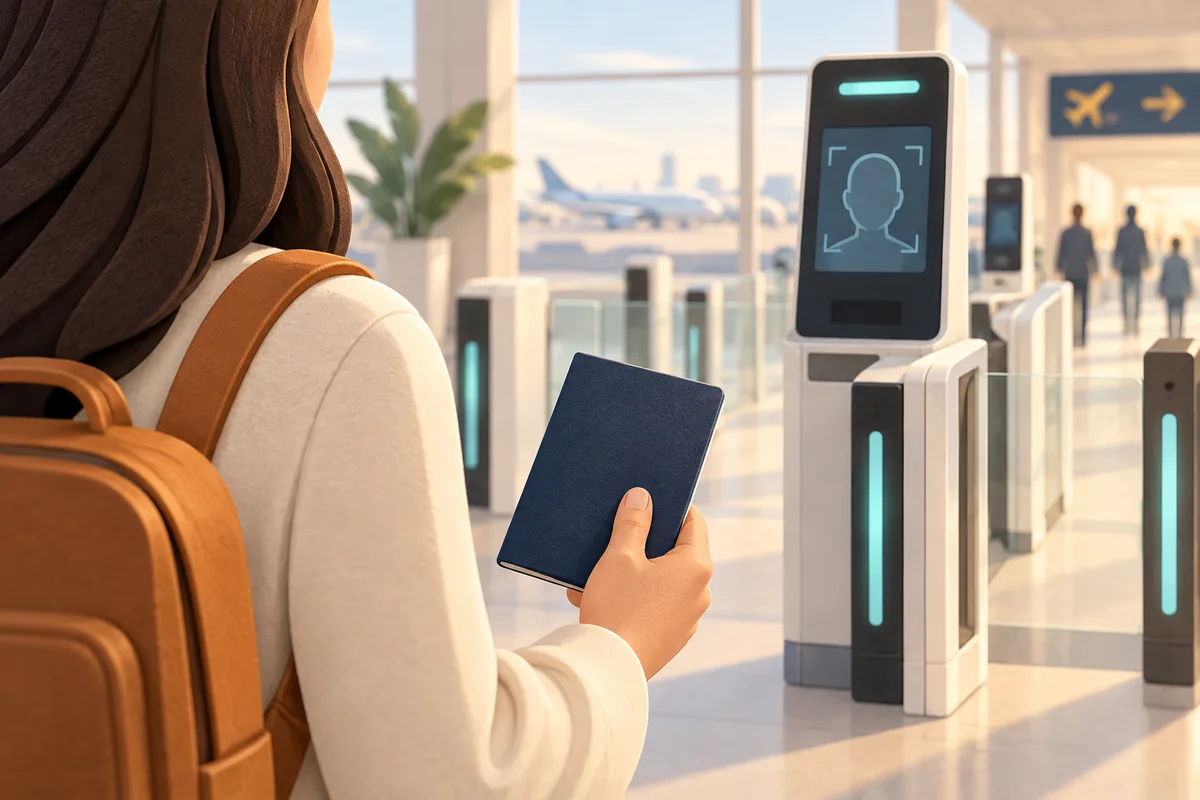
Yes: carry your valid passport. The UK’s new contactless eGates remove a passport-scanning step for eligible passengers at participating gates; they do not remove the travel-document requirement. Keep the passport accessible until you have finished border control.
Border Force’s publication history records new contactless guidance on October 6, 2026. Its contactless factsheet identifies a small initial deployment at East Midlands Airport. The practical decision is which arrival lane to follow, not whether to leave your passport at home.
Official guidance checked October 12, 2026. This is a source-based planning guide, not a test of gate speed or facial recognition. Featured image is an AI-generated editorial illustration, not a photograph of deployed equipment.
Choose the lane for your situation
Use this table to prepare a fallback before joining a queue. Local signs and Border Force instructions control the lane you actually use. If your permission requires an officer’s passport stamp, use that route: the general guide specifically identifies short-term Temporary Work – Creative Worker Certificate of Sponsorship arrivals.
| Your situation | What to prepare | What to do at arrival |
|---|---|---|
| British citizen arriving on a British passport at a participating contactless gate | Keep the passport within reach. | Follow the contactless instructions. Be ready to scan the passport if asked. |
| Eligible for ordinary eGates, but outside the initial contactless group | Plan for the existing passport-reader process. | Use the ordinary eligible lane rather than assuming a face-only lane is available to you. |
| British citizen at an airport or lane without the new service | Use the same document preparation as before. | Follow the available eGate or staffed-control instructions. |
| Family including a child who does not meet the eGate conditions | Check the youngest traveller’s eligibility first. | Ask staff for the appropriate family route; don’t split up just to try the new lane. |
| Gate asks for a passport scan or officer check | Have the document ready. | Follow that instruction. A fallback does not by itself explain why further checks are needed. |
Contactless eligibility is narrower than ordinary eGate eligibility
Do not treat “I have used a UK eGate before” as proof that the new contactless lane applies. Border Force’s general border guide says ordinary eGate users normally need a biometric passport, must be at least eight years old and 120cm tall, and eight-to-seventeen-year-olds must be accompanied by an adult. Nationality and immigration-status conditions also apply; check the full guide for your passport and permission.
The same guide describes contactless use from October 6 for British citizens entering on a British passport at participating airports. Other ordinary-eGate users should not assume that this initial entitlement includes them.
Example: two adults travelling together may need different arrival processes even if both used ordinary eGates on their last trip. Plan to regroup after each has completed the required checks; do not infer eligibility from your companion’s successful gate use. This is a planning example, not a reported passenger experience.
Is it available at Heathrow, Gatwick or Manchester yet?
The factsheet lists those airports within a phased rollout. A rollout list is not confirmation that a particular terminal or lane is operating today. The stated expectation of availability at all UK airports by early 2027 is a forecast, not a guaranteed date for your arrival.
Check airport instructions close to departure and follow the signs on arrival. Do not change airports or book a tighter onward connection solely because an airport appears on that list: this guidance supplies no measured queue-time saving for your flight.
A simple arrival checklist
- Before leaving home: check each traveller’s passport and the relevant entry permission. Contactless processing does not replace those checks.
- Before reaching the arrivals queue: take the passport out of its cover and keep it handy. The general guide advises removing hats, headphones and sunglasses, and keeping families together.
- At the gate: read the instruction for that lane. Do not substitute a phone image of the passport for a requested document scan.
- If redirected: use the passport reader or officer route indicated. The factsheet says these remain normal fallbacks when additional checks are required.
- Before continuing your journey: make sure your whole party has completed border control before moving on to transport or a transfer.
Keep three different airport decisions separate
Border control answers an entry question. It does not answer your outbound security-screening or airline baggage question. Our airport rules versus airline rules guide helps identify which organisation owns a restriction; it does not grant immigration permission.
For packing, put the passport on your carry-on checklist and keep it accessible rather than underneath everything you packed. For an airport choice, compare flight and ground-transport costs using the London airport total-cost guide. The new gate service alone is not evidence that a more expensive itinerary saves enough time to be worthwhile.
Your decision today: bring the passport, check the eligibility of every traveller, and choose the instructed arrival lane. Treat contactless processing as a possible convenience on that route, with the ordinary passport process ready as your fallback.