
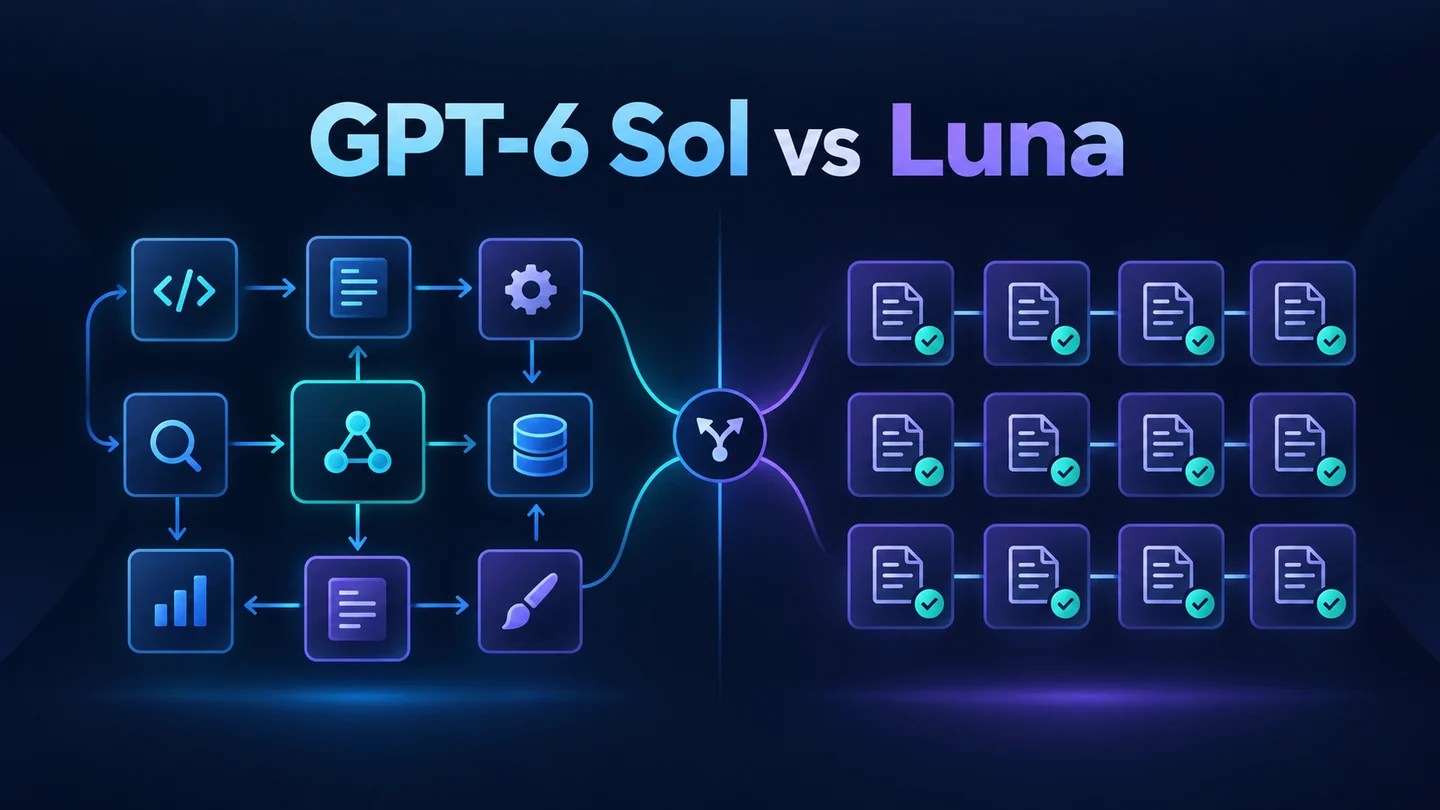
Quick answer — verified September 28, 2026. Choose GPT-6 Sol when the task needs judgment across several steps: diagnosing a difficult code failure, planning and implementing a change, or reviewing an agent’s work. Choose GPT-6 Luna when the job is clear, bounded and repeated often: small edits, extraction, triage or a batch of focused tasks. This is a task-routing rule, not a claim that either model always wins. OpenAI describes Sol as suited to complex coding and agentic workflows and Luna as its efficient option for focused, high-volume tasks. OpenAI’s September 22 release note and model-selection guide are the basis for that distinction.
Sol vs Luna: the practical decision table
| Your task | Start with | Why, and when to switch |
|---|---|---|
| Trace an intermittent test failure across files, decide on a fix, edit code and verify it | Sol | The work requires diagnosis, trade-offs and follow-through. Try Luna later for isolated cleanup once the cause is known. |
| Apply the same small, specified edit to many files | Luna | The acceptance rule is clear and repetition matters. Move to Sol if exceptions or conflicting requirements appear. |
| Review an agent’s patch for edge cases and test gaps | Sol | Judgment and careful verification are the main work. |
| Classify short items, extract fields or triage a large queue with a fixed rubric | Luna | Each item is focused. Sample the output and escalate ambiguous cases to Sol. |
| Draft from a precise brief, then resolve stakeholder conflicts | Luna for the draft; Sol for the conflicts | Split routine production from the part that needs judgment. Keep one model if switching adds more friction than value. |
These examples are editorial applications of OpenAI’s published task guidance, not PrismGist benchmark results.
For Codex: choose by the uncertainty in the coding task
Use Sol for an agentic change. Suppose a regression appears only after a configuration update. The agent must inspect several files, form a cause hypothesis, change code, run tests and assess the result. OpenAI calls Sol a model for complex coding and agentic workflows; its selection guide also places everyday coding and work needing judgment with Sol.
Use Luna for a bounded implementation. Suppose the failing test already identifies the exact function and you have specified the expected output. A small edit, test rerun or repeatable file update fits OpenAI’s examples of Luna for well-scoped problem solving and fine-grained edits. If the first attempt reveals a broader design conflict, switch to Sol and give it the failure, relevant files and acceptance criteria.
Do not assume a model label substitutes for a clear task brief or verification. For either model, state the desired result, constraints and tests. Compare both on the same representative task when model choice materially affects your workflow; retain the lighter setting that meets your quality bar, as OpenAI advises.
For ChatGPT Work: route focused volume and judgment separately
A Work task might process a queue of similarly formatted notes into a fixed set of fields. Luna is a sensible first choice for that focused, frequent work. A different task might reconcile contradictory documents and produce a recommendation with caveats. Sol is the better starting point when judgment and completeness matter. These are workflow examples, not measured speed or accuracy claims.
If you are deciding whether the job belongs in Work, Codex or ordinary Chat, use our Chat vs Work vs Codex guide. This page assumes you have chosen Work or Codex and need to pick Sol or Luna inside it.
Can you select both models on your plan?
OpenAI says GPT-6 Sol and Luna are rolling out to Plus, Pro, Business, Enterprise and Edu users in Work and Codex. Free and Go users can access Luna in the desktop app, subject to rollout. Availability depends on rollout and workspace settings; Enterprise administrators must enable the new models. OpenAI says these GPT-6 models are available in Work and Codex inside ChatGPT, not ordinary Chat. Check the model picker on your account before treating a missing option as a general plan rule. Source: OpenAI release note, September 22, 2026.
This article does not compare subscription value or allowance size. For your plan, surface and currently shown models, use the existing Plan & Model Checker. For allowance mechanics, see Codex Usage Limits; check its own verification date before relying on numbers.
A simple test before making one model your default
- Pick one real task you repeat and define what a correct, usable output looks like.
- Run the same brief with Luna and Sol, using the same available context and a comparable reasoning setting.
- Check the finished work, corrections needed and any failed cases. Use Luna for the bounded steps it handles well; reserve Sol for the steps where its judgment changes the result.
Verification date: September 28, 2026. Model descriptions and rollout caveats were checked against OpenAI’s ChatGPT & Codex changelog, model-selection guide and Work/Codex pricing and availability page. Rollout and workspace settings can change after this date.