
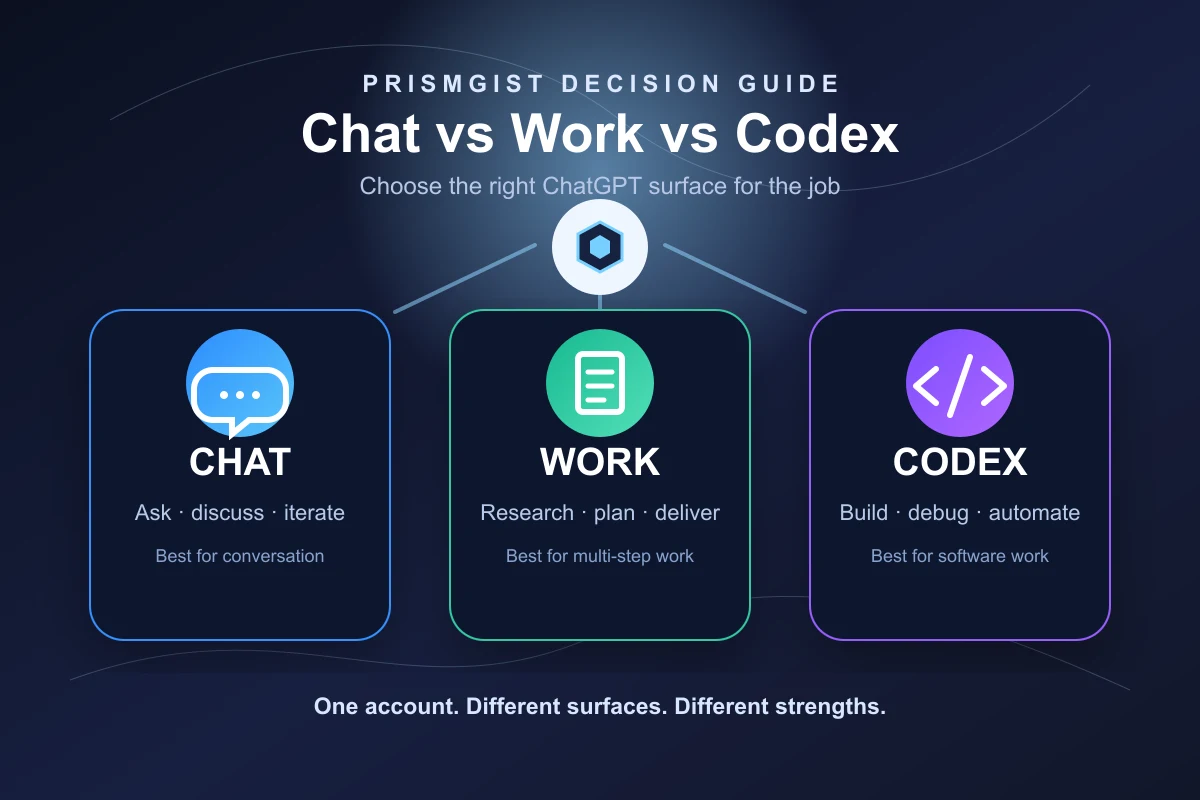
Current status — last checked September 8, 2026. ChatGPT now offers different surfaces for different jobs: Chat, ChatGPT Work and Codex.
The easiest way to understand them is not by asking which one is “best.” Ask what kind of work you are trying to do.
The short answer
Chat thinks with you. Work carries work through. Codex builds software.
| Surface | Best starting point when… | Typical result |
|---|---|---|
| Chat | you want discussion, explanation, iteration or changing direction | an answer, decision, draft or ongoing conversation |
| Work | you want a longer multi-step task carried to a finished deliverable | research, analysis, files/app work, finished output |
| Codex | the primary artifact is software | repository changes, code, tests, technical implementation |
There is overlap. The table is a routing rule, not a hard product boundary.
What is Chat?
Chat is the conversational ChatGPT experience.
Use it when the value comes from interaction:
- asking follow-up questions;
- challenging an assumption;
- changing the goal midstream;
- brainstorming;
- comparing strategies;
- explaining a difficult concept;
- refining writing or reasoning turn by turn.
Why Chat can be better even for a hard problem
Some hard problems are hard because the goal is still moving.
You may explore one strategy, reject it, change an assumption, ask for an adversarial review and then choose a different direction. That is naturally conversational.
A more agentic workflow is not automatically better when you want to steer the reasoning every few minutes.
What is ChatGPT Work?
OpenAI describes Work as an agent for longer, multi-step work and finished deliverables.
A useful contrast:
Chat: “Help me decide what this report should say.”
Work: “Use these files and sources, carry out the analysis, and produce the finished report.”
Use Work for jobs such as:
- multi-source research;
- analysis across several files;
- tasks involving connected tools/apps;
- longer document or artifact workflows;
- structured operational work;
- jobs with a clear destination and multiple execution steps.
Work is not just normal Chat with a different model
This matters during the current Astra rollout.
A plan can expose a model in Work before or without exposing the same model path in normal Chat. But that does not make the two experiences equivalent.
If you want conversational exploration, Work may be the wrong workflow even if it has access to a model you want.
What is Codex?
Codex is OpenAI’s dedicated software-development and technical-work surface.
Use Codex when the main result is a software change:
- inspect a repository;
- diagnose a bug;
- edit multiple files;
- implement a feature;
- run tests;
- review a diff;
- prepare a technical change set;
- work through code-specific tooling.
If the job is “change the software,” Codex is usually the natural starting point.
Work vs Codex: where is the boundary?
Look at the primary artifact.
If the result is mainly software, start with Codex.
If the result is mainly a research/business/work deliverable created through several steps and tools, start with Work.
| Task | Better starting surface |
|---|---|
| Fix a WordPress plugin bug | Codex |
| Research competitors and produce a recommendation | Work |
| Debate whether a product idea is worth building | Chat |
| Refactor an authentication subsystem | Codex |
| Analyze documents and prepare a report | Work |
| Challenge a business strategy | Chat |
| Implement an approved SEO plugin spec | Codex |
| Work across files/apps and return an operating brief | Work |
Some jobs cross the boundary. Start where the most important execution step belongs, then hand off deliberately.
Why GPT-6 Astra access can differ by surface
OpenAI currently says availability can differ between Chat, Work and Codex during rollout.
As of this update:
- GPT-6 Pro, powered by GPT-6 Astra, is rolling out in normal Chat for Pro $100, Pro $200, Business and Enterprise;
- Plus includes Astra in Work and Codex as rollout reaches the account;
- rollout is gradual.
So these statements can all be true for the same Plus user:
- “My account has Astra access.”
- “I can use Astra in Codex.”
- “I do not see Astra-powered GPT-6 Pro in normal Chat.”
The missing variable is the surface.
For the plan/upgrade question, use ChatGPT Plus vs Pro rather than turning this page into a pricing comparison.
Choose the surface before the model
A simple order prevents a lot of confusion:
1. Choose the job
Conversation, multi-step deliverable or software implementation?
2. Choose the surface
Chat, Work or Codex.
3. Choose enough model capability
Use the lowest-cost model that reliably solves the task. Move to a stronger model when additional reasoning changes the outcome.
This matters because high-end models can consume Work/Codex allowance much faster than lower-cost models. Detailed quota guidance belongs on the Codex Usage Limits page.
A hybrid workflow is often better
The three surfaces can cooperate.
Step 1 — Chat: decide
Use conversation to define the problem, challenge assumptions and set success criteria.
Step 2 — Work: research or assemble
If the task needs multi-source investigation, files or a finished non-code deliverable, use Work.
Step 3 — Codex: implement software
If the decision requires code, hand the approved implementation contract to Codex.
Step 4 — Chat: judge the outcome
Bring back the measured result and decide whether to continue, revise or stop.
This prevents expensive execution from starting before the goal is clear.
Example: launching an SEO tool
Weak workflow
Ask Codex to research the market, decide what to build, build it, publish it and judge whether it will make money.
That mixes strategy, research, implementation and business judgment into one open-ended task.
Better workflow
Chat: choose the experiment and kill criteria.
Work: gather/structure evidence if the research is large and multi-source.
Codex: build the approved minimum implementation and tests.
GSC/Analytics: collect evidence.
Chat: decide SCALE / HOLD / KILL.
The right surface reduces decision drift as well as usage waste.
What about Work and Codex usage?
OpenAI says Work follows the Codex usage structure. Do not assume moving a task from one surface to the other creates a completely independent pool of high-end model usage.
For current allowance tables, five-hour ranges, weekly limits and model-routing tactics, use the dedicated Codex Usage Limits guide.
Bottom line
Use this mental model:
Chat for steering. Work for carrying. Codex for building.
Choose the surface first. Choose the model second.
If an announced OpenAI model is missing from Chat, Work or Codex, use the model availability guide to check the surface, rollout, account and workspace before changing your workflow.
If you want a personalized recommendation based on plan, task and preferred surface, use the ChatGPT Plan & Model Checker.
Official sources
Last rechecked September 8, 2026:
- OpenAI Help Center — ChatGPT Work and Codex
- OpenAI Help Center — GPT-5.6 and GPT-6 Pro in ChatGPT
- OpenAI Codex pricing
FAQ
Is ChatGPT Work the same as Chat?
No. OpenAI describes Chat as conversational assistance and Work as a longer multi-step agent for finished deliverables.
Is Codex the same as Work?
No. Codex is dedicated to software development and technical work. Work is broader and centered on multi-step work and deliverables.
Why can I see Astra in Codex but not normal Chat?
Model access can differ by surface. Current OpenAI guidance gives Plus Astra in Work/Codex as rollout reaches the account, while Astra-powered GPT-6 Pro in normal Chat is a different plan path.
Which surface should I use for coding?
Codex is the dedicated software-development surface and is normally the best starting point for repository implementation work.
Which surface should I use for research?
Use Chat when you want to reason through the research interactively. Use Work when you want a longer multi-step research task carried through to a finished deliverable.
For the complete decision map, return to ChatGPT Plans & Models.