
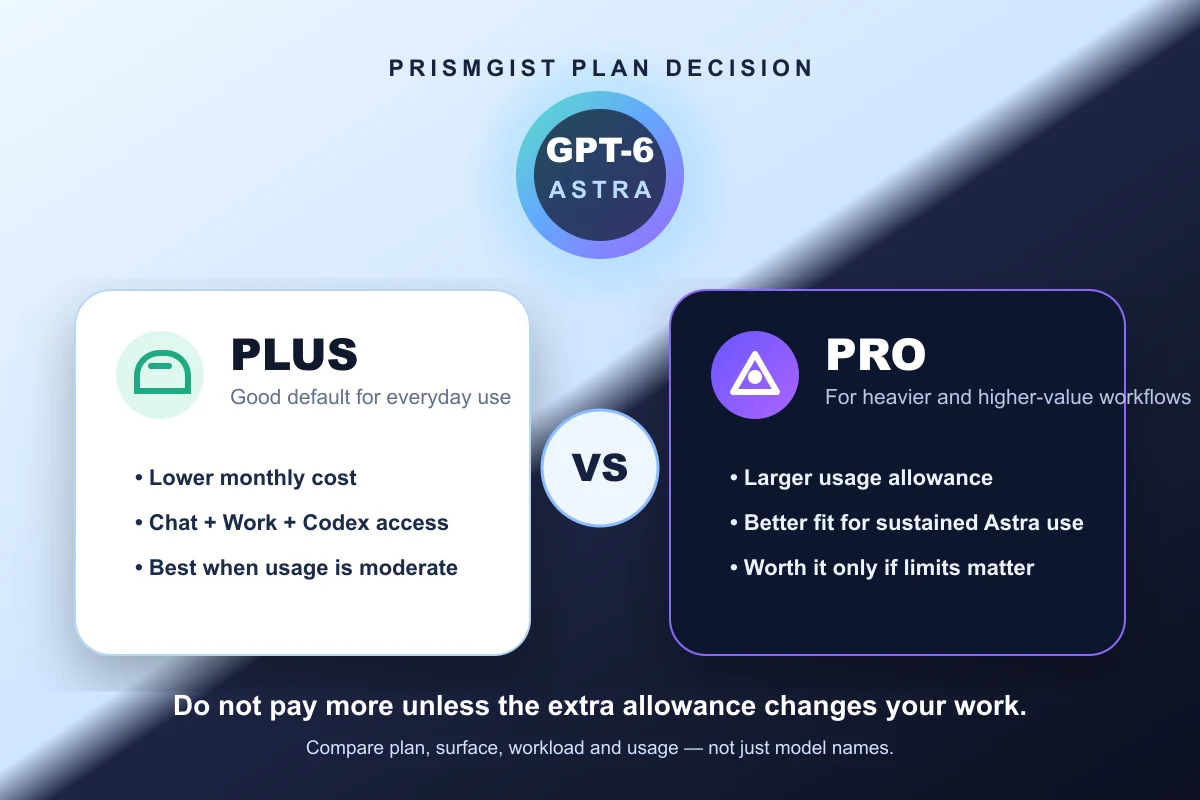
Current status — last checked September 8, 2026. GPT-6 Astra makes the Plus-vs-Pro decision unusually confusing because access depends on both plan and surface.
OpenAI currently says Plus includes GPT-6 Astra in ChatGPT Work and Codex as rollout reaches the account, while GPT-6 Pro, powered by Astra, is rolling out in normal Chat for Pro $100, Pro $200, Business and Enterprise.
So the real question is not “Which plan has Astra?”
It is:
Do you need Astra in normal Chat, and does your workload justify paying for more sustained capacity?
The short answer
Stay on Plus if Astra is mainly an occasional hard-task tool, Work/Codex fits those tasks, and limits do not repeatedly stop valuable work.
Consider Pro if either of these is true:
- you specifically want Astra-powered GPT-6 Pro in normal conversational Chat; or
- Plus Work/Codex capacity repeatedly interrupts high-value daily work even after sensible model routing.
A newer model alone is not a business case for upgrading.
Plus vs Pro: the current decision table
| Decision | Plus | Pro $100 / $200 |
|---|---|---|
| Astra-powered GPT-6 Pro in normal Chat | Not the current Plus Chat path | Rolling out |
| Astra in ChatGPT Work | Limited usage as rollout reaches account | Uses larger included Pro allowance as rollout reaches account |
| Astra in Codex | Limited usage as rollout reaches account | Uses larger included Pro allowance as rollout reaches account |
| Optional extra credits for supported Work/Codex usage | Available where flexible usage is supported | Available where supported |
| Credits force earlier rollout | No | No |
| Best fit | Selective high-end use | Sustained high-value use / normal GPT-6 Pro Chat access |
Rollout is gradual. OpenAI says availability can differ between Chat, Work and Codex, so eligibility does not guarantee that every account sees the same option at the same moment.
Reason 1 to upgrade: normal Astra Chat matters to you
This is the cleanest upgrade case.
Work and Codex are not identical substitutes for a normal conversation. OpenAI describes:
- Chat as conversational assistance;
- Work as longer multi-step work and finished deliverables;
- Codex as software development and technical work.
If your best work happens through repeated back-and-forth — strategy, difficult analysis, exploratory reasoning, challenging assumptions, changing direction — access to Astra only in an agentic surface may not solve the same problem.
If Astra-powered GPT-6 Pro in normal Chat materially improves that workflow and you use it often, Pro buys a meaningful product difference.
If you only need Astra for occasional bounded jobs, Plus can remain the better value.
Reason 2 to upgrade: limits are blocking valuable work
The second strong case is throughput.
OpenAI currently gives Pro substantially more Work/Codex capacity than Plus. Exact usage depends on model and task, and current message ranges are estimates rather than guarantees.
Do not ask only:
“Did I ever hit the limit?”
Ask:
“How often did the limit stop work that mattered?”
A limit that appears once during experimentation is an inconvenience.
A limit that repeatedly stops client work, deployment, research or revenue-producing output is an operating cost.
For the current detailed model-by-model usage table and quota-conservation tactics, use PrismGist’s Codex Usage Limits guide rather than relying on this plan page.
When Plus is probably the better value
Stay on Plus when most of these describe you:
- Astra is used selectively, not by default;
- Work or Codex is an acceptable surface for Astra tasks;
- lower-cost models handle routine work well;
- you rarely lose productive time to usage limits;
- usage varies heavily from week to week;
- occasional credits cover unusual spikes more cheaply than a permanent upgrade.
The important principle is simple:
Do not pay a recurring premium for capacity you do not actually consume.
When Pro becomes rational
Pro has a stronger case when several of these are true:
- you need Astra-powered GPT-6 Pro in normal Chat;
- Work/Codex is part of your paid workflow every working day;
- Plus limits repeatedly interrupt that workflow;
- you routinely need difficult reasoning, large context or long multi-step execution;
- buying extra credits has become normal rather than occasional;
- the value of time recovered is larger than the recurring price difference.
The strongest Pro buyer is not simply an AI enthusiast. It is someone whose workload monetizes the additional access or capacity.
Plus + credits vs Pro
Credits and subscriptions solve different shapes of demand.
Plus + credits fits spiky demand
Use this pattern when:
- overage happens only occasionally;
- one deadline creates a temporary spike;
- most months stay within Plus;
- the relevant feature supports credit-based extension on your account.
Pro fits persistent demand
A larger plan makes more sense when high consumption happens every week and you actually use the extra included capacity.
Use this rough comparison:
effective monthly cost = subscription + typical credits + value of productive time lost to limits
This is a decision framework, not a claim that every minute has a precise dollar value.
Run a one-week test before paying more
Before upgrading, collect your own evidence.
Day 1: keep Plus
Do not change the plan yet.
Route models deliberately
Reserve Astra for high-uncertainty or high-consequence jobs. Use lower-cost models for routine execution.
Record forced stops
Each time a limit actually prevents useful work, record it.
Record credit spend
Track real overage rather than estimating it from memory.
Review after one working week
Ask:
Did Plus merely annoy me, or did it materially reduce output?
If the second answer repeats every week, Pro has a real business case.
What if you use an API key instead?
Codex can also be used with an API key, in which case usage follows API pricing rather than the included ChatGPT-plan allowance.
That can be useful for controlled developer workloads, but API billing and a ChatGPT Pro subscription are different products. Compare your actual workload instead of assuming one is always cheaper.
Decision tree
Do you specifically need Astra-powered GPT-6 Pro in normal Chat?
- Yes → Pro is currently the direct individual-plan path.
- No → continue.
Do Plus Work/Codex limits repeatedly stop valuable work?
- No → stay Plus.
- Yes → continue.
Is the overage occasional?
- Yes → Plus + supported credits may be more economical.
- No → continue.
Have you already reduced waste by routing routine work to lower-cost models?
- No → optimize first.
- Yes → Pro deserves serious consideration.
For an account/task/surface recommendation, use the ChatGPT Plan & Model Checker.
Bottom line
For most users, GPT-6 Astra existing is not enough reason to upgrade.
Upgrade when the higher plan solves a recurring bottleneck:
- the exact Chat experience you need is tied to Pro; or
- Plus throughput is consistently too small for valuable daily work.
If neither is true, keep Plus and spend high-end model capacity selectively.
Official sources
Last rechecked September 8, 2026:
- OpenAI Help Center — ChatGPT Work and Codex
- OpenAI Help Center — GPT-5.6 and GPT-6 Pro in ChatGPT
- OpenAI Codex pricing
- OpenAI Help Center — Using credits for flexible usage
FAQ
Does ChatGPT Plus include GPT-6 Astra?
Current OpenAI guidance says Plus includes Astra in ChatGPT Work and Codex as rollout reaches the account. Astra-powered GPT-6 Pro in normal Chat is currently a different plan path.
Do I need Pro to use Astra in Codex?
No. Plus includes limited Astra usage in Codex as rollout reaches the account.
Can credits replace Pro?
They can be economical for occasional supported overage. They are less compelling when high consumption is persistent every week.
Will credits make Astra appear sooner?
No. OpenAI says buying credits does not provide early rollout access.
Is Pro automatically better value?
No. Extra capacity has value only when your workload actually uses it.
For the complete decision map, return to ChatGPT Plans & Models.
Still choosing a workflow? Use ChatGPT Chat vs Work vs Codex or get a direct answer from the ChatGPT Plan & Model Checker.