
An AI subscription can feel indispensable because one answer impressed you. It can also feel useless because one difficult task went badly. Neither memory is a reliable record of what the subscription contributes to your week.
This template helps you make a keep, cancel, downgrade or test-longer decision using completed work rather than feature lists. It contains a seven-day log, a comparison summary and an explicitly fictional example.
Get the AI Subscription Audit Template
A seven-day task log and summary for deciding whether a paid AI plan earns its recurring cost.
Direct file download. No account, timer or ad interaction required.
- Format and size
- XLSX — 14,407 bytes
- Version
- 1.0
- Requirements
- An XLSX-compatible spreadsheet app. No macros, account connection or external data feed.
- Source and reuse
- Original PrismGist workbook with a fictional example. It is not a provider benchmark. No separate reuse license is asserted.
How to use it
Choose real tasks and acceptance checks before testing. Log accepted work and active correction time; keep private prompts, credentials and client documents out of the workbook.
Related resources
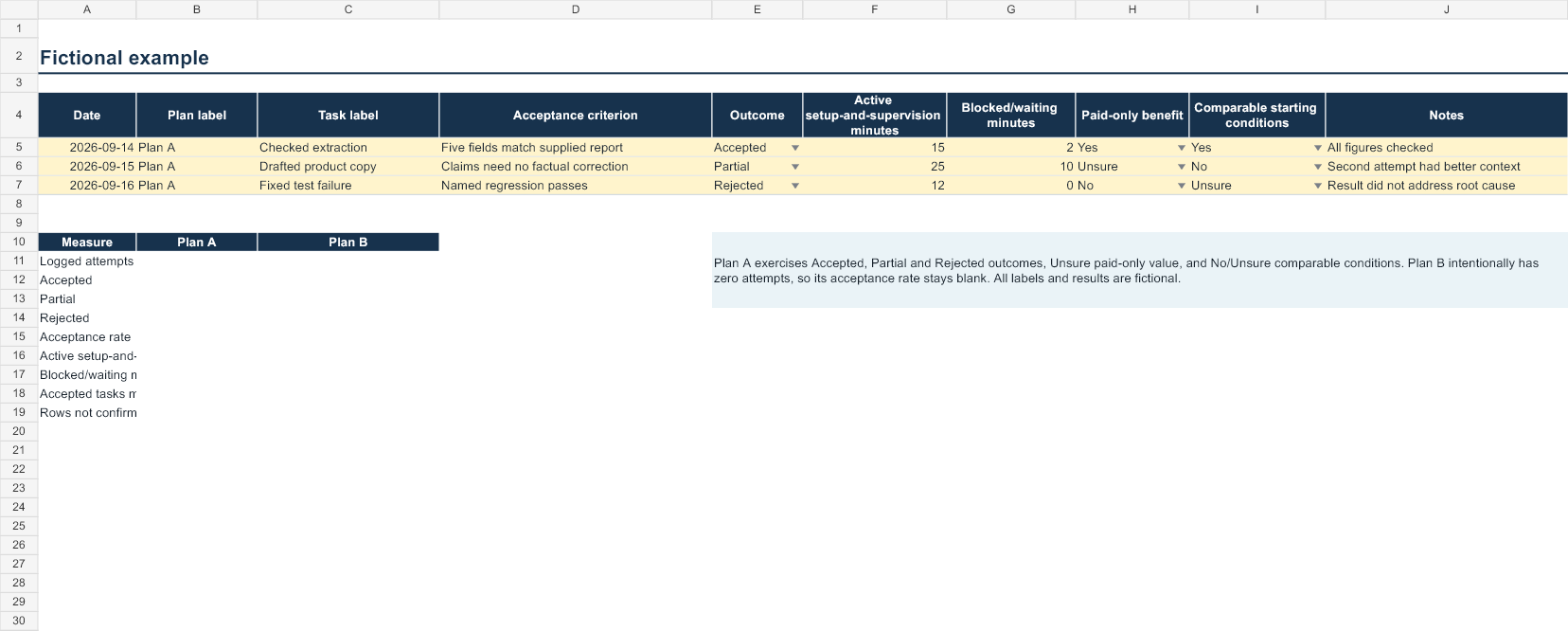
It is not a benchmark and does not rank providers. It does not need current model names or a permanent claim about which AI is smartest.
Decide what counts as useful before testing
Choose a few tasks you genuinely need to complete: fixing a specific bug, summarising a document, preparing a product description or extracting information into a checked table.
Write an acceptance condition before seeing the result. “A good answer” is too flexible. “The table contains these five fields and every figure matches the supplied report” is something you can verify.
Record whether the output was accepted, partially useful or rejected. Do not count a polished-looking result as completed work while ignoring the corrections it still needs.
Compare comparable access
Record the plan and product surface used. Comparing a paid coding agent with a free chat session may answer whether that particular combination works for you; it does not establish a paid-plan-versus-paid-plan winner.
Use equivalent starting material and acceptance criteria. For repeated tasks, vary which product you try first so the second attempt does not always benefit from what you learned during the first.
You do not need to subscribe to every provider. An existing free or trial experience can screen possibilities, but mark its limits rather than pretending it proves the performance of a plan you did not test.
Count your work, not just the AI’s waiting time
Record active minutes spent preparing context, correcting output, checking facts and integrating the result. Keep waiting or usage-limit interruptions in a separate field.
A tool that produces an answer quickly but requires twenty minutes of repair may save less effort than one that takes longer and needs little supervision. Waiting is also different from active labour when you can work on something else during it.
The workbook does not combine all these measures into a mysterious score. It shows the underlying counts so you can identify the trade-off.
Mark paid-only value carefully
Ask what the subscription added beyond access you already have. Was the useful work dependent on a paid feature or allowance? Was an included storage or workflow benefit something you would otherwise buy?
Do not give a benefit a cash value just because the marketing page lists it. Record an avoided expense only when you would genuinely incur that expense without the bundle.
Likewise, estimated time saved is not automatically cash earned. It becomes financially useful only when the freed time matters to you or enables work you actually complete.
Read a small sample honestly
Suppose one plan produced five accepted tasks from eight attempts and another produced four from seven. That alone does not settle the purchase: the tasks may differ in difficulty, importance or supervision required.
Look at the kinds of accepted work, total active minutes and recurring interruptions. Then identify the feature you would genuinely miss.
Seven days is an observation window, not a scientific guarantee. A quiet week or one unusual project may be unrepresentative. “Test longer” is a valid result when the evidence is weak.
Make the decision explicit
Keep a plan when its recurring contribution justifies its actual cost. Consider downgrading when a lower tier covers the work you repeatedly use. Consider cancelling when the benefits are mostly hypothetical and you have a workable alternative.
Before changing a subscription, check its current billing, cancellation, storage and access consequences in your own account. This worksheet does not manage billing or see your account.
For feature-level comparisons, use PrismGist’s ChatGPT Plus vs Claude Pro or ChatGPT Plus vs Google AI Pro guides. Use this audit to test whether those differences matter in your own work.
Download and privacy
Use task labels rather than pasting private prompts, client documents or credentials into the workbook. The file stays wherever you save it. PrismGist does not need your completed log.
The workbook contains no macros, account connection or external data feed. The example is fictional, not a test result obtained from any provider.
Is the summary a provider ranking?
No. It summarises your logged work and leaves the decision to you.
Should I multiply one week’s time savings into a monthly income claim?
No. Any extrapolation needs explicit assumptions and is not earned revenue.
What if I cannot decide after seven days?
Keep the unresolved question visible and test a representative task, rather than inventing confidence from a tiny sample.
For a plan-level purchase comparison, see ChatGPT Plus vs Pro.