
On 11 October 2026, IndiGo flight 6E6115 from Delhi to Chennai diverted to Hyderabad. The Indian Express reported a power-bank fire; the IndiGo spokesperson it quoted confirmed smoke from a passenger’s personal electronic device and a safe landing. Those are different levels of confirmation. The report says an investigation was launched; it does not establish a final cause, device model, charging activity or passenger rule breach.
The practical question for your next flight is where to put your own power bank. The incident alone cannot establish that one storage position is always safe, or that it prompted a new airline rule.
Quick answer: cabin-only does not mean anywhere in the cabin
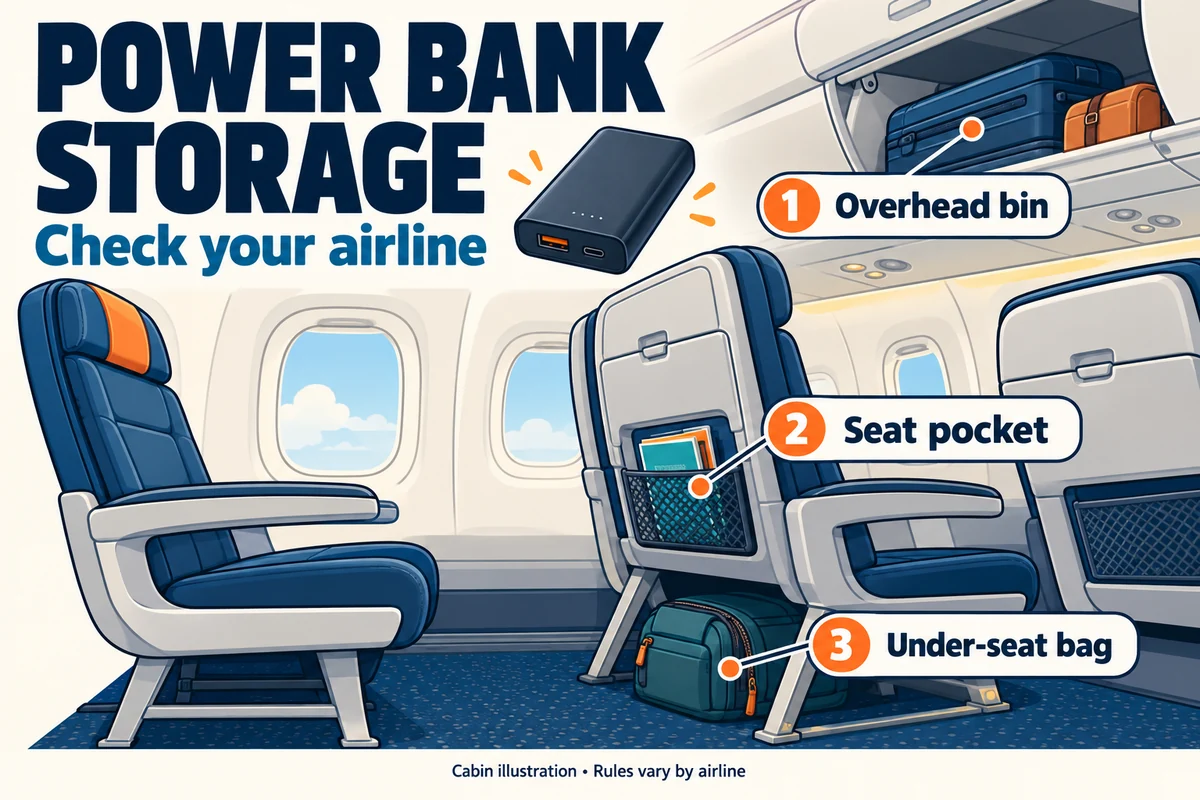
Follow the operating airline’s policy and the crew’s instructions. Keep an accepted power bank in a permitted place where it stays accessible and can be monitored. Before lifting your suitcase into an overhead bin, check whether the bank must come out. A seat pocket is an option only when the airline allows it; a bag under the seat is not a guarantee against a battery incident.
News and official guidance checked 19 October 2026. The incident occurred on 11 October, before this policy check. Airline policies can change. This guide addresses storage and access, not a complete capacity or carriage-approval decision.
The FAA’s baggage guidance says power banks must remain in carry-on baggage, accessible and protected from damage, accidental activation and short circuits. That US guidance does not replace a particular carrier’s more specific storage or use restrictions. The examples below show why the distinction matters.
Decide before your bag leaves your hands
Use three questions in order: Is this location allowed? Can I reach the bank without retrieving a stowed suitcase? Can I notice a problem? “It is somewhere in my cabin bag” answers none of them fully. Accessibility and visibility are related, but a bank buried inside an under-seat backpack is not continuously visible.
| Your situation | Decision before stowing | What not to assume |
|---|---|---|
| Cabin suitcase going into the overhead bin | Check the carrier’s location rule before lifting it. On Ryanair or Emirates, remove the power bank and put it in the carrier-permitted location below. If the rule is unclear, ask the crew before stowing. | A cabin-bag allowance does not grant permission to put a power bank overhead. |
| Backpack under the seat in front | Where that location is permitted, choose a compartment you can access without unpacking the whole bag. Protect the bank individually rather than leaving terminals against loose metal items. | Being under the seat does not make a bank visible through the bag or eliminate risk. Permission to store is not permission to charge. |
| Seat pocket | Use it only if the airline permits it and the crew accepts the placement. Check it again when leaving the aircraft. | Emirates expressly allows a seat pocket; that does not establish permission on another airline. |
| Cabin bag taken for gate checking | Remove the power bank before handing the bag over and retain it in the cabin in an allowed location. Tell staff before surrendering a bag if you cannot access the bank. | A bag that was cabin luggage is not still cabin luggage once it is sent to the hold. Use our gate-check removal checklist for the other items. |
| Connection involving more than one airline | Check each operating carrier and plan a location permitted on each leg. Recheck at a crew or aircraft change. | The company selling the ticket, or the first flight’s rule, does not settle the next airline’s policy. |
The accessible-compartment suggestion is a packing aid, not a new airline requirement. For the gate-check rule and individual protection, see the FAA guidance checked on 19 October. For how the different rule owners fit together, see airport rules versus airline rules.
Three airline examples: storage, phone charging and recharging are separate
Each entry was checked on 19 October 2026. These are carrier-specific examples, not a worldwide rule. “Not specified on the checked page” is a limit of that source, not permission to do it.
| Airline and official source | Where to keep it | Use it to charge a phone? | Recharge the power bank? |
|---|---|---|---|
| Ryanair: terms, section 8.4 | On your person or in the cabin bag under the seat in front. Not in cabin baggage in an overhead locker. A seat-pocket option is not specified on the checked page. | Permitted except during taxi, take-off and landing, or when crew instruct otherwise. | Not permitted onboard at any time, including one power bank charging another. |
| easyJet: “Power banks” entry and safety notice | The safety notice says cabin bag and easily monitored. The dangerous-goods entry recommends a monitorable place, such as on your person. Specific overhead or seat-pocket instructions are not specified on the checked pages; ask the crew about your intended placement. | Not permitted: the entry prohibits power-bank use and charging other devices. | Not permitted: the safety notice explicitly says power banks cannot be charged during the flight. |
| Emirates: onboard power-bank rules | Seat pocket or a bag under the seat in front. Not in the overhead bin. | Not permitted onboard. | Not permitted using the aircraft’s power supply. |
Emirates announced those rules on 8 August 2025, effective 1 October 2025. They predate the October 2026 IndiGo incident. Its general dangerous-goods page is broader; use the specific power-bank announcement for these placement and use instructions.
Carriage permission remains a separate check: the capacity label, quantity, condition and airline restrictions still matter. This article does not resolve differing capacity wording across authorities or airline pages, and does not turn a storage example into approval for a particular Wh rating. Use the checker and confirm the current operating-carrier policy, especially if published limits disagree.
Under the seat is not a promise of safety
In a separate report, Yonhap described a suspected power-bank fire in a passenger’s bag under a seat on Air Seoul RS511 at Incheon on 24 September 2026, before take-off. It was not an in-flight incident, and the suspected device was not an established final cause in that report.
That is a reason to distinguish a permitted storage location from a guarantee. Choosing an allowed, accessible position supports noticing and reporting a problem; it does not prove that a battery cannot fail there.
If the bank becomes unusually hot, swollen, smoky or burning
Alert the cabin crew immediately and follow their instructions. The FAA’s PackSafe guidance specifically tells passengers to report overheating, expansion, smoke or burning; crews are trained to respond. Do not wait for flames before reporting an abnormal device.
This is not a situation for repacking it out of sight, carrying a burning device down the cabin or trying to repair a damaged battery. Get the crew’s help rather than attempting your own battery-fire procedure. If you already know a bank is damaged, defective or recalled before boarding, the FAA says it must not be carried; contact the airline instead of packing it for the flight.
A short check before boarding
- Check every operating carrier’s storage rule, separately from its charging and capacity rules.
- Choose the permitted place before your larger bag goes overhead or is handed over at the gate.
- Keep the bank individually protected and accessible; do not bury it among loose metal items.
- Ask the crew if your seat, bag or intended position does not fit the published instructions.
- Check your seat pocket and under-seat area before leaving the aircraft.
Next step: use the Power Bank Flight Checker to check your airline and the capacity shown on your device. Read the linked carrier policy too: an allowed battery still needs an allowed place to travel.
Featured image: original AI-generated cabin illustration showing storage locations to check with your airline. It is not a depiction of either reported incident and does not mark every location as permitted.