
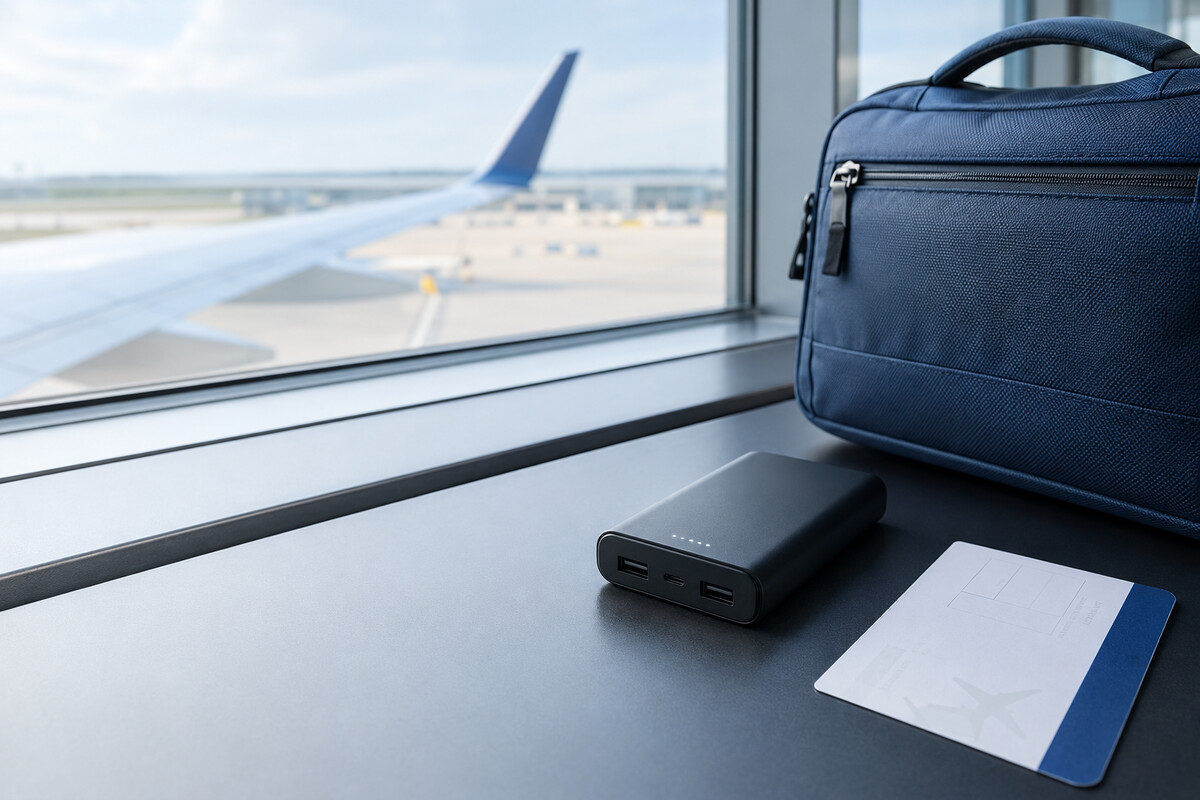
Short answer: a normal power bank usually belongs in your carry-on, never in checked baggage. But the usable limit, number allowed, where you can store it, and whether you may use it onboard now vary by airline. Use the checker below for every operating carrier on your itinerary.
Free travel tool
Can your power bank fly?
Enter the label details and select every operating airline in your itinerary. The checker applies the strictest result.
Popular power-bank flight questions
- Can you take a 20,000mAh power bank on Ryanair?
- Can you take a 20,000mAh power bank on easyJet?
- Can you use a power bank onboard Ryanair or easyJet?
- Is a 27,000mAh power bank below the flight limit?
Ryanair and easyJet rules rechecked August 29, 2026; other carrier rows checked August 21, 2026. This page is planning guidance, not approval from an airline, airport, or security authority.
The four checks that decide whether your power bank can fly
A generic “yes” from a search result is not enough. Before leaving for the airport, confirm all four of these details on the physical device:
- Condition: do not travel with a swollen, cracked, leaking, overheating, damaged, or confirmed-recalled battery.
- Energy rating: find the watt-hour value, written as Wh. If the label gives only milliamp-hours and nominal voltage, estimate it with Wh = mAh × V ÷ 1,000.
- Operating airline: check the carrier flying the aircraft, including each codeshare or connection—not only the company that sold the ticket.
- Quantity and storage: count every portable charger, keep terminals protected, and be ready to remove them from any bag taken at the gate.
When two airlines have different rules, follow the stricter rule for the whole trip unless you can safely change what you carry between flights. The checker applies that principle automatically.
What changed in 2026
The old shortcut—“under 100 Wh means it is fine”—is incomplete. The International Civil Aviation Organization adopted a new baseline effective March 27, 2026: passengers may carry no more than two power banks, and power banks must not be recharged from aircraft power. Airlines can impose tighter restrictions.
Several carriers now also require power banks to stay within reach instead of in an overhead bin. Some prohibit using them to charge another device in flight. Southwest is unusually strict: its published limit is one power bank from April 20, 2026. That is why a live, carrier-specific check is more useful than a static “TSA-approved” claim.
2026 rules for 15 major airlines
This is a travel-planning summary. Open the linked airline page before departure, particularly if your bank is above 100 Wh, its rating is hard to read, or your itinerary changes.
| Airline | Practical 2026 limit | Use and storage | Primary source |
|---|---|---|---|
| American Airlines | 2; up to 100 Wh each | Within reach; not overhead; use only while visible; do not recharge | American |
| Delta Air Lines | Conservative check: 2; over 100 to 160 Wh needs approval | Under-seat or seat pocket; no use during taxi, takeoff, or landing; no recharging | Delta |
| Southwest Airlines | 1; up to 100 Wh | Under the seat and visible while used; do not recharge | Southwest |
| JetBlue | 2; up to 100 Wh each | Not overhead; the carrier says it should not power another device; no recharging | JetBlue |
| Alaska / Hawaiian | Conservative check: 2; over 100 to 160 Wh needs approval | Within arm’s reach; remove from a gate-checked bag | Alaska |
| Air Canada | Conservative check: 2; airport-agent approval over 100 to 160 Wh | Cabin only; remove from any bag placed on a Sky Check cart | Air Canada |
| British Airways | 2; up to 100 Wh each | Seat pocket or under-seat bag; not overhead; no recharging | British Airways |
| Lufthansa Group | 2; over 100 to 160 Wh needs approval | Not overhead; no use or recharging | Lufthansa Group |
| KLM | 2; over 100 to 160 Wh needs approval | Keep with you; not overhead; no use or recharging | KLM |
| Ryanair | 2; up to 100 Wh each | On person or under-seat; not overhead; no bank recharging; device charging outside taxi, take-off and landing | Ryanair |
| easyJet | 2; checker requires confirmation over 100 to 160 Wh because official pages conflict | Keep where it can be monitored; no use or recharging in flight | easyJet |
| Wizz Air | Conservative check: 2; up to 100 Wh each | Cabin only; protect against activation and short circuit | Wizz Air |
| Iberia | 2; up to 100 Wh each | On your person, in the seat pocket, or under-seat; no use or recharging | Iberia |
| SAS | 2; up to 100 Wh each | Not overhead; no use or recharging | SAS |
| Air France | Conservative check: 2; approval over 100 to 160 Wh | Not overhead; no use or recharging | Air France |
How to read the label without guessing
Use the printed Wh rating whenever it exists. A common 20,000 mAh bank at a 3.7 V nominal cell voltage is approximately 74 Wh: 20,000 × 3.7 ÷ 1,000. A 30,000 mAh bank at 3.7 V is approximately 111 Wh, which crosses the 100 Wh threshold and may need airline approval—or may be refused entirely by a carrier with a 100 Wh ceiling.
Do not substitute the USB output voltage of 5 V if the label supplies a different nominal battery voltage. If the rating is missing, illegible, internally inconsistent, or impossible to calculate, treat that as an airport problem waiting to happen. Bring the manufacturer specification or choose a clearly marked bank.
A model number can reveal a recall—but not clear one
The checker includes a targeted launch list of recent official recall notices for models including Anker A1263, A1647, A1652, A1257, A1681 and A1689; INIU BI-B41; VEEKTOMX VT103; Casely E33A; and Belkin BPB002 and PB0003. Some recalls affect only certain serial numbers or markets. A model match therefore means stop and verify, not that every unit with that model is recalled.
The reverse is equally important: no match in this tool does not prove a device is safe. Check the manufacturer’s recall page and the relevant national product-safety database if the bank is old, unusually hot, damaged, second-hand, or from an unfamiliar seller.
Packing checklist for the airport
- Put every power bank in cabin baggage. Never deliberately pack one in checked baggage.
- Cover exposed terminals or place each bank in its own protective pouch.
- Keep it accessible under the seat, in the seat pocket, or on your person when the airline requires this.
- If cabin baggage is taken at the gate, remove the power bank before handing the bag over.
- Do not recharge the bank onboard. Follow the carrier’s rule on using it to charge another device.
- Stop using it immediately if it becomes hot, expands, smokes, smells unusual, or behaves erratically; notify cabin crew.
- Save the airline’s written approval when travelling with a bank above 100 Wh.
Frequently asked questions
Can a power bank go in checked luggage?
No. A power bank is a spare lithium battery and belongs in the cabin. Remove it if a carry-on bag is checked at the gate.
Is a 20,000 mAh power bank allowed?
Usually, when its nominal voltage is 3.7 V, because that is about 74 Wh. Still check the printed Wh rating, the condition of the bank, its model and recall status, the quantity you carry, and every operating airline.
Is a 30,000 mAh power bank allowed?
Not automatically. At 3.7 V it is about 111 Wh. Some carriers may accept it only with advance approval; several airlines in this guide cap power banks at 100 Wh.
Does “TSA approved” mean every airline accepts it?
No. It is not a universal approval category. Security rules, hazardous-material rules, airline policy, the operating crew, route, and local authorities can all matter.
Can I use a power bank during the flight?
It depends on the carrier. Ryanair currently permits charging a personal device except during taxi, take-off, landing or crew restriction. easyJet prohibits using the bank to charge another device during the flight. Lufthansa Group, KLM, Iberia, SAS and Air France also publish use restrictions; ask the crew whenever the rule is unclear.
Method and limitations
PrismGist transcribed the carrier rows from the airlines’ own baggage or dangerous-goods pages and applies a conservative international baseline from ICAO. For US regulatory context, see the FAA PackSafe lithium-battery guidance. Recall matches link to official notices from the US Consumer Product Safety Commission or the manufacturer.
Rules can change without notice and may differ for medical equipment, mobility aids, crew-authorized exceptions, regional operations, and aircraft types. The checker does not inspect a device, identify counterfeit labels, determine battery chemistry, or issue approval. The operating airline and authorities make the final decision.
[…] Power Bank Checker […]
[…] Power Bank Checker […]
[…] Power Bank Checker […]