
easyJet power-bank pages checked on 29 August 2026. Two official easyJet surfaces still publish different Wh ceilings; the conservative treatment below keeps that conflict visible.
Quick answer
A typical 20,000mAh power bank at a nominal 3.7V is about 74Wh and falls below both easyJet thresholds currently published on its official pages. You may carry no more than two, in cabin baggage only. Protect each bank individually, keep it somewhere it can be monitored, and do not recharge it or use it to charge another device during the flight.
easyJet 20,000mAh decision table
| Check | Current planning answer |
|---|---|
| Typical 20,000mAh at 3.7V | About 74Wh; below both current easyJet figures |
| Maximum quantity | Two power banks per customer |
| Checked baggage | Not permitted; cabin baggage only |
| Protection | Individually protected against short circuit |
| Storage | Keep where it can be monitored; on your person is recommended |
| Recharge or use onboard | Neither action is permitted during the flight |
Why 20,000mAh is usually about 74Wh
The mAh number alone does not tell an airline the battery’s energy. At a nominal cell voltage of 3.7V, the common planning conversion is:
20,000 × 3.7 ÷ 1,000 = 74Wh
Use the device’s printed Wh rating whenever it exists. A manufacturer may use a different nominal voltage, and the product name may round the capacity. Do not use the 5V USB output in the formula when the battery label provides another nominal voltage. If no reliable Wh value can be found, treat the device as needing clarification before travel.
The two easyJet rules that matter after capacity
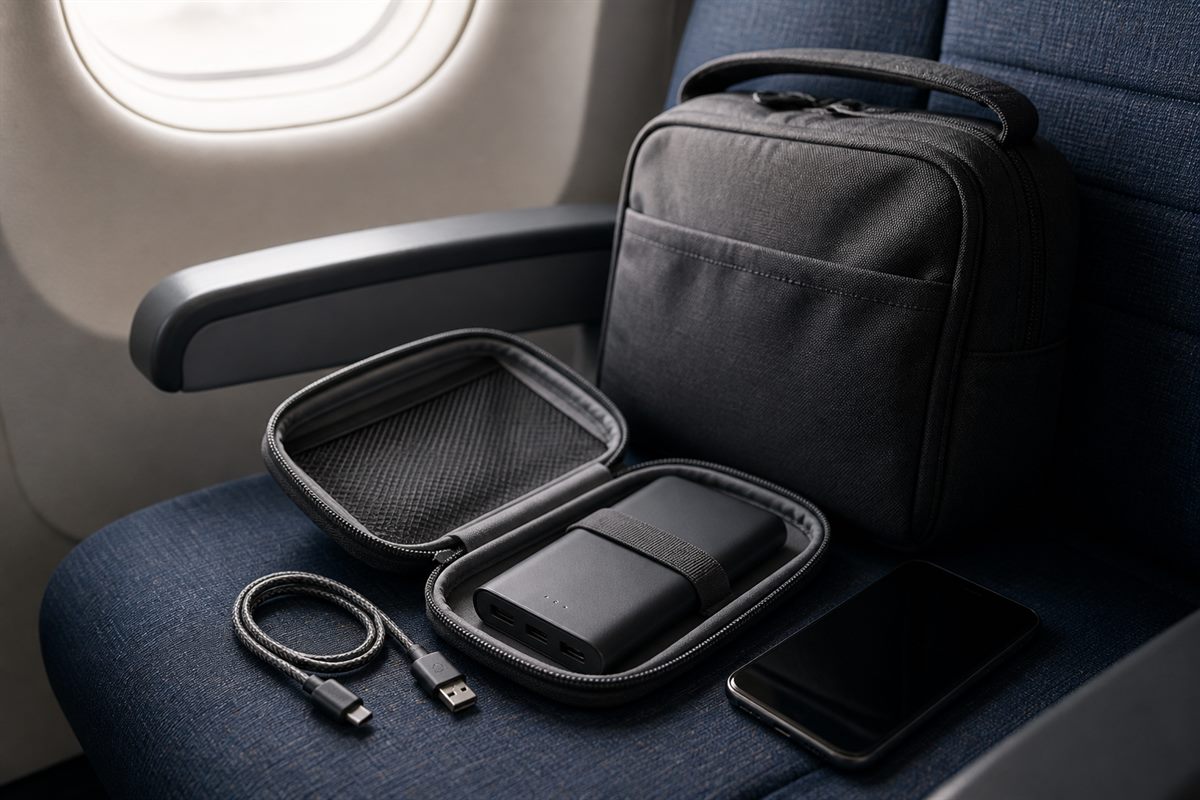
First, the bank must stay in cabin baggage. Remove it if a bag is taken at the gate for the hold. easyJet recommends keeping power banks where they can be monitored, such as on your person. Each one should be individually protected, for example in its original retail packaging or a separate protective bag.
Second, carrying and using are different questions. easyJet’s current safety notice says a power bank cannot be charged from aircraft power and cannot be used to charge another device during the flight. That rule differs from Ryanair’s current limited permission, which is explained in the Ryanair versus easyJet onboard-use comparison.
Important: easyJet’s official Wh pages still conflict
easyJet’s main Dangerous Goods page currently says power banks up to 160Wh are accepted, while an easyJet Holidays help page still states a 100Wh maximum. A typical 20,000mAh/74Wh bank falls below both figures. For a power bank above 100Wh, verify the current rule for your booking directly with easyJet before relying on the higher threshold.
This conflict does not change the 74Wh answer, but it does change how PrismGist handles larger banks. The checker deliberately treats the 100–160Wh range as confirmation-required instead of presenting 160Wh as universal no-friction acceptance. Do not rely on a generic “easyJet allows 160Wh” summary for a device above 100Wh.
What can make a 20,000mAh bank unsuitable?
- Its actual Wh label is unexpectedly high. The physical rating overrides the usual 74Wh estimate.
- You carry more than two. easyJet currently permits a maximum of two power banks per customer.
- It is packed in checked luggage. Move it into cabin baggage before bag drop or gate check.
- The terminals can short circuit. Use individual packaging or a protective pouch.
- The bank is damaged, swollen, hot, leaking or recalled. A compliant rating is not a safety clearance.
- A connection uses a stricter carrier. Check the airline operating every flight segment.
A practical packing check
- Find the printed Wh rating and model number.
- Count all banks and keep the total at two or fewer.
- Protect each bank separately against short circuit.
- Place it in cabin baggage where it can be monitored.
- Remove it before any bag goes into the hold.
- Do not recharge it or use it to charge another device onboard.
Summary
A normal 20,000mAh bank at 3.7V is approximately 74Wh, below both easyJet ceilings still visible in official guidance. Check the actual label, carry no more than two in cabin baggage, protect them individually and keep them monitorable. Neither recharging the bank nor using it to power another device is permitted during the flight.
Official sources
- easyJet: Dangerous Goods and power banks
- easyJet: Latest travel information and power-bank safety notice
- easyJet Holidays: lithium battery/power-bank help
- ICAO: 2026 power-bank restrictions
Source check: 29 August 2026. Airline pages can change; confirm the operating carrier’s current answer for any bank above 100Wh.