
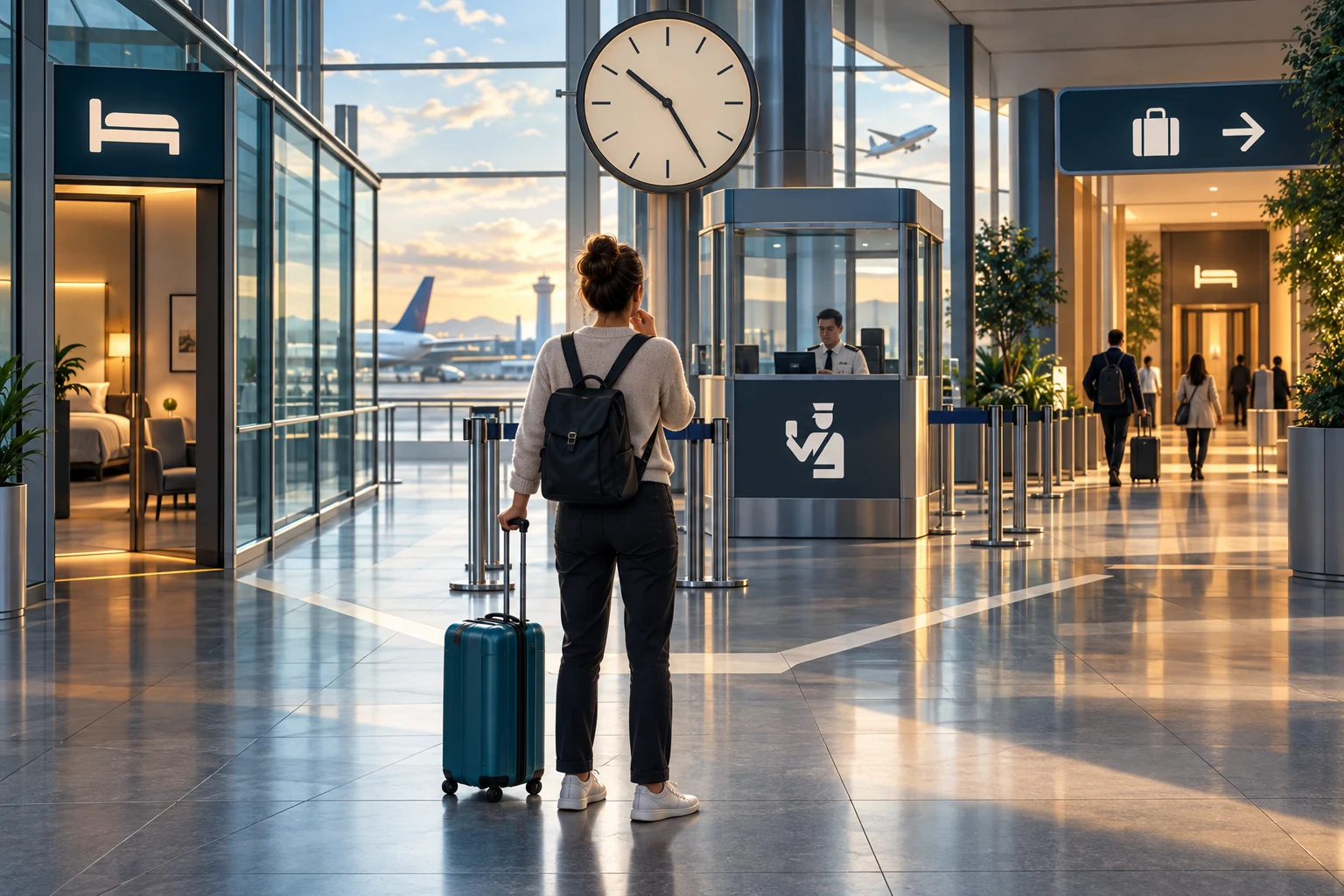
Choose an airport hotel by access first, usable room time second, and total price third. “At the airport” does not tell you whether you can reach the room while remaining in transit. An airside room can be inaccessible from your terminal or itinerary; a landside room can require permission to enter the country and another trip through departure security.
Official airport and hotel sources checked 6 October 2026. This is a planning method, not a hotel review, a visa decision or a prediction of airport queues. All timed itineraries and prices below are fictional assumptions.
Airside or landside: start with the route to the door
| Question | Airside / transit hotel | Landside / public-area hotel |
|---|---|---|
| Can I reach it? | Confirm your arrival route, terminal, onward boarding pass and hotel eligibility | Confirm you may enter the country, exit arrivals and return for your flight |
| What must I cross? | Check transfer controls and permitted terminal connections; airside does not mean no further screening | Map border formalities, hotel transfer and return departure controls |
| Where are my bags? | Do not assume access to through-checked luggage | Include reclaim, storage and recheck if your itinerary requires them |
| Is the room available then? | Verify room-service hours, exact check-in/out and any minimum booking block | Verify day-use versus overnight check-in and the return transport schedule |
Sketch the actual path: arrival gate → required controls → hotel → required controls → departure gate. Mark each terminal and whether each leg is public or controlled. Use the airline and airport instructions for your booking. The connecting-flight security guide explains why staying airside does not eliminate every checkpoint. The self-transfer versus one-booking guide covers the separate question of booking protection and who manages the connection.
If entry permission is unresolved, a landside room is not yet a bookable plan. Check the destination’s border authority using your nationality, documents and itinerary. For Singapore, start with ICA’s entering/transiting guidance; for the UK, use the official visa checker. A hotel confirmation does not grant border entry or airside access.
Changi: Jewel is public; the transit hotels are a different choice
Changi’s current hotel directory lists Changi Transit Hotel in the T1/T3 departure transit halls and tells guests not to clear immigration to reach them. It lists YOTELAIR in Jewel’s public area, requiring arriving transit passengers to clear immigration. It also announces the T2 Ambassador hotel’s operator transition to Changi Transit Hotel from 3 November 2026: check your stay date, not an old hotel name.
The Changi Transit Hotel access FAQ requires a valid onward boarding pass and remaining in transit. Its luggage FAQ says checked luggage cannot be accessed during the stay. Pack necessary medication, clothing and toiletries in your permitted cabin bag.
Booking units also differ: the operator’s stay-duration FAQ states a six-hour minimum. YOTELAIR’s own Jewel page confirms its landside location and four-hour minimum for hourly bookings. Neither minimum tells you how much sleep your connection permits. Ask about your precise time block, terminal route and occupancy before paying.
Heathrow: inside a terminal does not mean airside
Heathrow lists Aerotel in Terminal 3 Arrivals, and Aerotel’s London FAQ confirms it is landside and cannot be accessed directly from the airside transit area.
Heathrow separately lists No1 Bedrooms after security in T3 for connecting passengers, with daytime room hours of 06:00–22:30 and an instruction to use a nearby hotel for an overnight stay. That airport listing is not a confirmed room reservation: its booking link could not be verified in this source check, so we do not treat it as an available option for your dates. Confirm current service, room hours and eligibility with the operator before relying on it. Do not substitute lounge opening hours for bedroom hours.
Calculate room time, then estimate your rest window
Work backwards from the airline’s required gate/boarding deadline, not only scheduled take-off. Write down your own deadline and departure airport advice. Do not replace them with a generic “arrive X minutes before” rule.
Planned room time = layover − arrival formalities − transfer to hotel − check-in − check-out − return transfer − return controls − gate walk − contingency − departure-to-required-gate margin.
Count each task once. Include deplaning, transfer screening, border checks, bag reclaim/recheck or terminal transport where your route needs them. If formalities or screening are already included in one allowance, do not subtract them again. Subtract eating, showering, settling and waking preparation from room time to obtain a planned rest window. Rest time is not guaranteed sleep.
Two eight-hour layovers, very different room windows
Every minute in this table is an invented planning allowance. These are unnamed fictional airports and itineraries, not Changi or Heathrow queue estimates. Both flights arrive at 10:00 and depart at 18:00; assume both travellers must reach the gate at 17:15. Traveller A is eligible for a reachable airside room with through-checked bags. Traveller B has confirmed entry permission but must reclaim/recheck bags and use a landside hotel.
| Allowance (minutes) | A: airside | B: landside |
|---|---|---|
| Headline layover | 480 | 480 |
| Arrival tasks, including applicable controls/bags | 25 | 80 |
| Transfer to hotel | 15 | 35 |
| Hotel check-in | 10 | 15 |
| Check-out | 10 | 10 |
| Return transfer | 0 (gate walk below) | 35 |
| Return controls, including required screening/recheck | 0 (none assumed on this route) | 60 |
| Gate walk | 20 | 20 |
| Additional contingency | 30 | 45 |
| Departure-to-required-gate margin | 45 | 45 |
| Planned room time | 325 = 5h25m | 135 = 2h15m |
| Shower/settling/waking allowance | 25 | 25 |
| Planned rest window | 300 = 5h | 110 = 1h50m |
A reaches the room at 10:50 and plans to leave at 16:15. B reaches it at 12:10 and leaves at 14:25. If either arrival is 60 minutes late while all later deadlines remain fixed, subtract another hour from the room window. Test a less favourable case before committing. If an unknown control or unreliable transfer can consume the useful rest window, ask for confirmation or skip the hotel rather than trimming the gate deadline.
Compare what you pay for, not just an hourly headline
Use your own current quote: room block × rooms + mandatory fees/taxes + transfers + needed bag storage. Record currency, included guests, minimum charge, cancellation deadline, no-show policy and whether a delayed arrival changes the booking. Confirm any early departure from a minimum block with the hotel.
Fictional cost example, unrelated to the named hotels: assume A pays 120 currency units for a six-hour block and no transfer; B pays 90 for a four-hour block plus 20 for transfers. B’s total of 110 is lower, but costs about 48.89 per planned room hour (110 ÷ 2.25), versus A’s 22.15 (120 ÷ 5.4167). This is a comparison method, not a live quote or a claim that airside rooms are always better.
Changi Transit Hotel’s terms make cancellation/amendment depend on the selected rate plan and include non-refundable plans. Do not assume every hourly booking is flexible. The Travel Budget Spreadsheet helps separate total cost, already-paid amounts and money still needed using your own quotes.
The final book / check first / skip decision
- Book: access, bags, terminal route, exact room block, return deadline and total cost are confirmed; your conservative rest window is worth the spend to you.
- Check first: one required fact is unknown—entry permission, boarding pass access, room hours, recheck, transport or cancellation terms. Resolve it before a non-refundable booking.
- Skip: you cannot legally or operationally reach the room, or the realistic room window is too small for the rest you want. A long headline layover alone is insufficient.
Recheck the route and room conditions when flights or operators change. We did not stay at these hotels, test queues or make a reservation. The featured image is an original AI-generated conceptual illustration, not a map of either airport.